Climb Milling Vs Conventional Milling Guide
Choosing between climb and conventional milling determines the tool life, surface finish, and geometric accuracy of machined parts. This technical guide delivers an engineering evaluation of both methods for optimizing production.
Principles of Cutting Tool Interactivity with Materials
In high-precision manufacturing, selecting the correct cutting strategy defines the cost-per-part efficiency and final mechanical properties of a component. Mechanical engineers and procurement teams sourcing components through premium china cnc facilities must analyze tool-to-workpiece interaction mechanics. The distinction between climb cutting and conventional cutting relies on the rotational direction of the spindle relative to the feed movement.
During climb cutting, also known as down milling, the cutter rotates with the direction of the feed force. The flute engages the material at its maximum chip thickness and tapers down to zero as it exits the cut. This mechanical engagement produces a downward chip load that presses the raw stock firmly into the workholding fixtures. This downward force stabilizes setups on complex multi-axis assemblies, which is why top-tier china cnc service providers implement it for tight-tolerance designs.
Conversely, conventional milling (or up milling) features a spindle rotation that opposes the direction of the feed. The cutter tooth starts its engagement at zero chip thickness and climbs up to its maximum thickness at the exit point. This sliding engagement generates friction and localized heat distortion before the cutting edge successfully sheers the parent metal. This friction increases tool rub, accelerating mechanical wear when running complex geometries through china cnc machining production cells.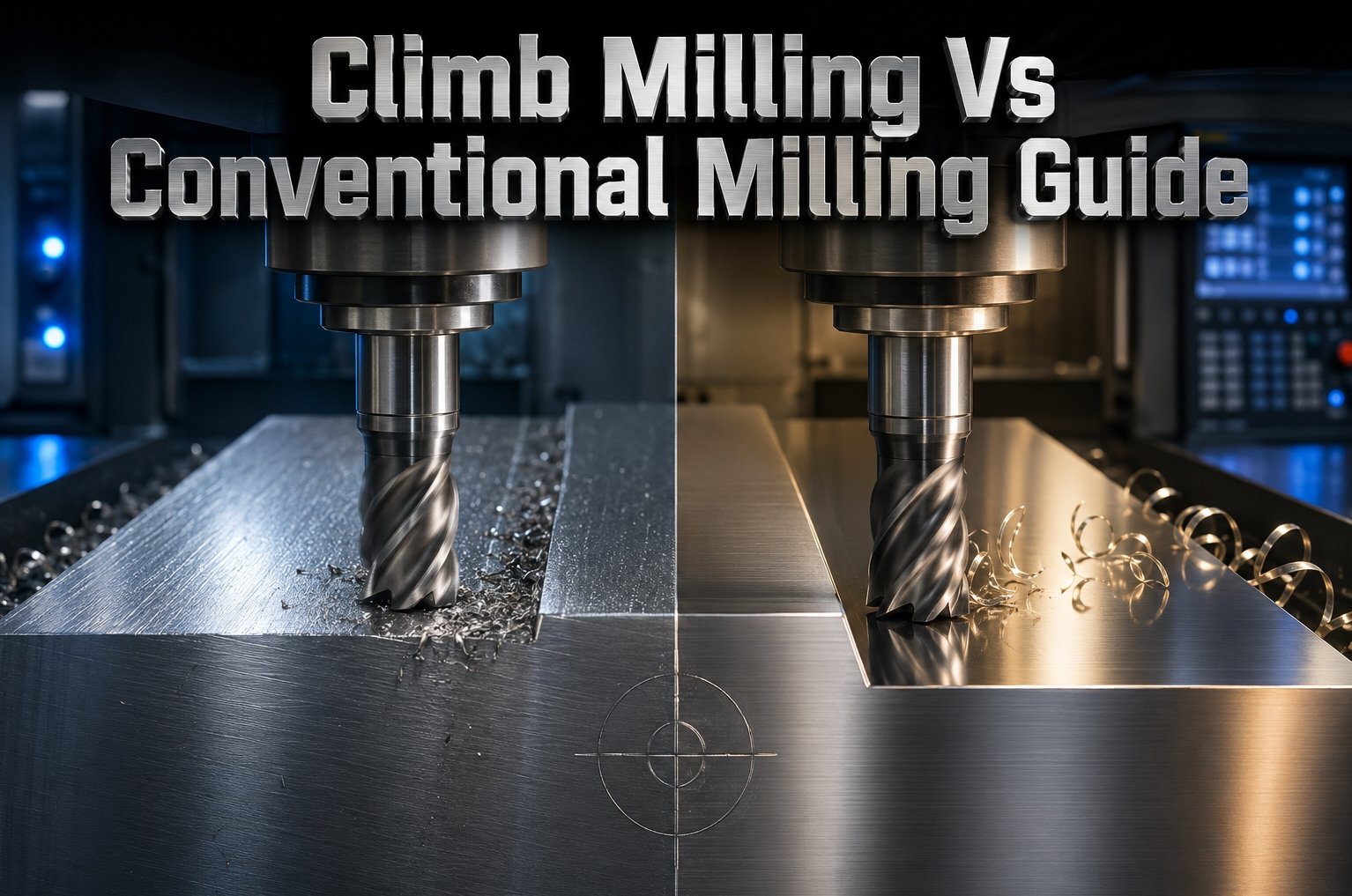
Understanding these structural differences allows engineering buyers to choose the right production paths. Sourcing teams rely on highly equipped china cnc machining suppliers who utilize advanced CAM tools to apply automated toolpath strategies. This technical mastery ensures optimal chip clearing and maintains the structural integrity of your high-volume orders.
Technical Insight Block: What is Tool Deflection and Backlash?
Tool deflection occurs when the lateral radial cutting forces exceed the static rigidity of the end mill, causing the tool to bend slightly away from its intended pathway. Backlash describes the structural play or clearance within a machine’s lead screw or ball screw drive mechanisms. In vintage manual hardware, climb milling can pull the workpiece directly into the backlash zone, resulting in tool breakage. Modern CNC machines feature anti-backlash ball screws and rigid linear guides, making climb milling the primary approach for high-precision operations.
Mechanical Differences: Chip Load, Tool Life, and Deflection
The mechanical forces generated by climb and conventional milling impact tool life and part surface finish. Because climb cutting initiates material removal at maximum thickness, it allows the shear heat to pass efficiently directly into the expelled chip rather than building up within the cutting edge or the workpiece. This thermal management extends tool life when executing high-velocity cnc turning china or multi-axis milling sequences.
Conventional milling forces the cutting tool to scrape along the work surface before biting into the metal. This rubbing hardens the surface layer of alloys like stainless steel or high-tensile carbon steels, making subsequent passes more difficult. To mitigate this work-hardening phenomenon, seasoned engineers utilize specialized toolpaths when managing complex multi-stage runs through premium cnc services china shops.
| Mechanical Parameter | Climb Milling (Down Milling) | Conventional Milling (Up Milling) | Impact on CNC Output Metrics |
|---|---|---|---|
| Initial Chip Thickness | Maximum Value (At Entry Point) | Zero Value (At Entry Point) | Determines chip-load dynamics and initial tool shock load |
| Cutting Force Vector | Downward Force (Stabilizes Setup) | Upward Force (Lifts Workpiece) | Influences fixture rigidity requirements and part stability |
| Tool Wear Characteristics | Low Frictional Wear; High Uniformity | Accelerated Chipping; Flute Rubbing | Directly alters total tooling replacement costs over long runs |
| Surface Roughness (Ra) | Superior (Smooth, Consistent) | Poorer (Prone to Scoring and Chatter) | Alters cosmetic value and limits secondary finishing processes |
Tool deflection patterns also differ between these two processes. In climb configurations, the tool deflects away from the finished surface profile, which prevents accidental gouging. Conventional milling deflects the tool slightly inward into the finished profile, which can cause geometric errors during tight-tolerance manufacturing. Sourcing precision parts from a trusted china machining facility ensures your designs are audited via rigorous CAM simulations to counteract these deflection errors.
Application Guidelines: Roughing, Finishing, and Castings
Deciding when to use climb or conventional milling depends on the structural condition of the raw material. For example, machining hot-rolled steels or rough castings presents challenges like abrasive surface scales or sand pockets. Under these circumstances, conventional milling is preferred for the initial roughing pass. Because the cutter starts beneath the surface skin and lifts upward, it avoids direct contact with abrasive surface inclusions, protecting the cutter’s edge.
However, for finishing passes across all material types, climb milling remains the industry standard. The clean shearing action produces minimal tool chatter and achieves a superior surface finish ($R_a < 0.8\ \mu\text{m}$). This is critical for internal features, sealing faces, and cosmetic assemblies machined by experienced technicians via cnc machining china cells.
Request a Technical Quote from Our Engineering Team Today
When dealing with thin-walled aerospace brackets or thin electronics enclosures, the upward vertical forces of conventional milling can pull or deform the part out of alignment. Utilizing climb toolpaths on high-speed china cnc milling equipment secures uniform cross-sections and avoids scrapping expensive aerospace alloys.
Sourcing High-Precision Components via China Infrastructure
Procuring advanced multi-axis assemblies requires a manufacturer that blends state-of-the-art hardware with proven technical knowledge. Choosing a professional partner for your cnc milling china requirements gives your company access to scalable manufacturing networks, advanced raw alloy options, and reliable post-processing options.
According to published production whitepapers from the American Society of Mechanical Engineers (ASME), implementing optimized multi-axis climb milling strategies across modern CNC centers lowers localized mechanical strain by up to 28%. This reduction in mechanical strain translates directly to tighter part tolerances and improved repeatability across long production runs.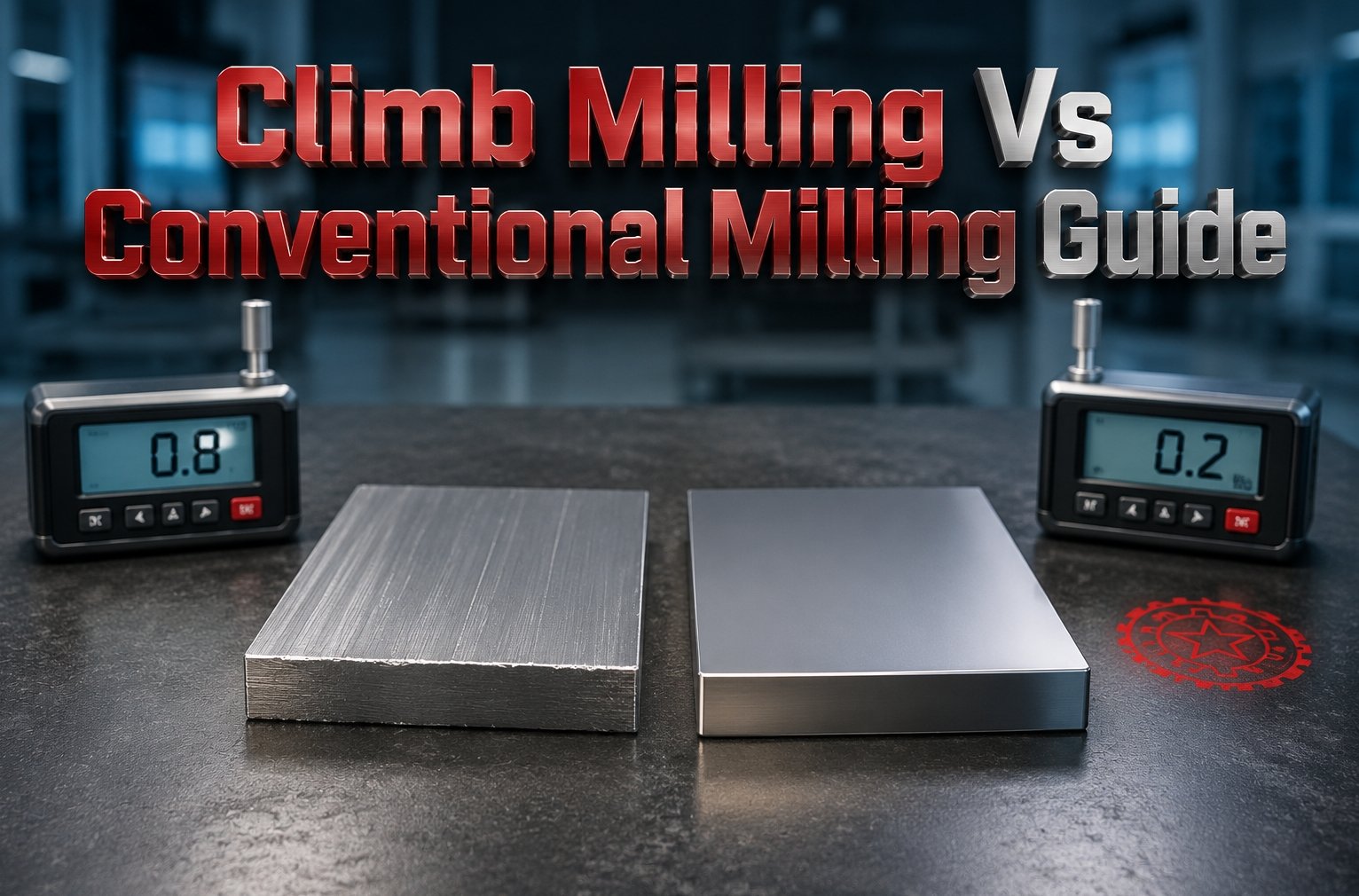
Leading operations pair advanced machining practices with rapid hardware development. Whether you need an initial functional cnc prototype china assembly to verify physical properties or high-volume series runs, selecting an ISO 9001:2015 certified shop ensures your parts comply with international engineering standards.
Optimizing Feed Rates and Fixturing for Advanced Milling
Maximizing manufacturing throughput relies on calculating accurate feeds, speeds, and tool positioning for both cutting styles. When utilizing high-feed climb strategies, the downward clamping forces allow for higher feed rates without inducing chatter. However, because the tool experiences sudden shock loads upon entry, engineers must optimize entry moves using spiral or helical ramp profiles rather than direct vertical plunges.
For conventional milling layouts, workholding fixtures must be designed to counter the upward forces pulling the raw stock off the machine bed. Heavy-duty hydraulic or pneumatic fixtures are used to stabilize materials during deep roughing cuts, preventing micro-vibrations from damaging the surface finish. To review advanced engineering techniques or reference global standard specifications, procurement teams often consult materials databases hosted via the ASTM International standards network.
Contact Our Engineering Desk to Upload Your CAD Files for a Free DFM Review
When your design requires complex, multi-sided machining or internal features, matching the right milling technique to each step of the process is critical. Sourcing from a partner that combines elite china prototyping capabilities with long-term manufacturing infrastructure allows you to bring your designs to market with lower lead times and minimized overhead costs.