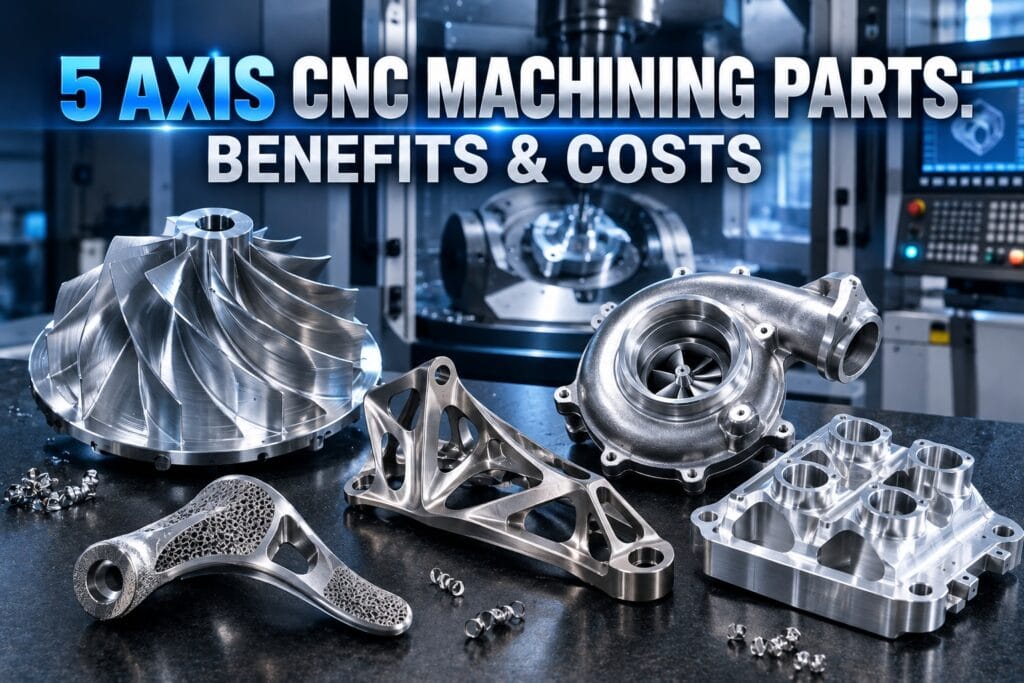
Sourcing tight-tolerance components for complex geometries often leads to excessive setup delays, dimensional stack-up errors, and inflated production costs. Partnering with an experienced cnc machining parts supplier unlocks multi-axis precision, streamlining production cycles while maintaining tight geometric tolerances across complex aerospace, medical, and automotive applications.
Understanding 5-Axis CNC Machining: Technical Fundamentals
5-axis CNC machining involves moving a cutting tool or part across five different axes simultaneously. Traditional 3-axis machines operate along the linear X, Y, and Z axes. Multi-axis systems add rotation around two of these linear axes: the A-axis (rotation around the X-axis), B-axis (rotation around the Y-axis), or C-axis (rotation around the Z-axis). This dynamic motion allows cutting tools to approach the workpiece from any direction, enabling the production of highly complex, contoured geometries without multiple re-fixtures.
Technical Deep-Dive: What is GD&T in Multi-Axis Machining?
Geometric Dimensioning and Tolerancing (GD&T) is a standardized symbolic language (ANSI/ASME Y14.5) used on engineering drawings to explicitly define the allowable variation of geometric features. In 5-axis manufacturing, GD&T parameters such as Position, Profile of a Surface, Perpendicularity, and Runout are critical. By completing features in a single setup (3+2 or continuous 5-axis), manufacturers eliminate “datum shift”—the cumulative error introduced when repositioning a part across different fixtures—thereby guaranteeing strict adherence to true position and profile tolerances.
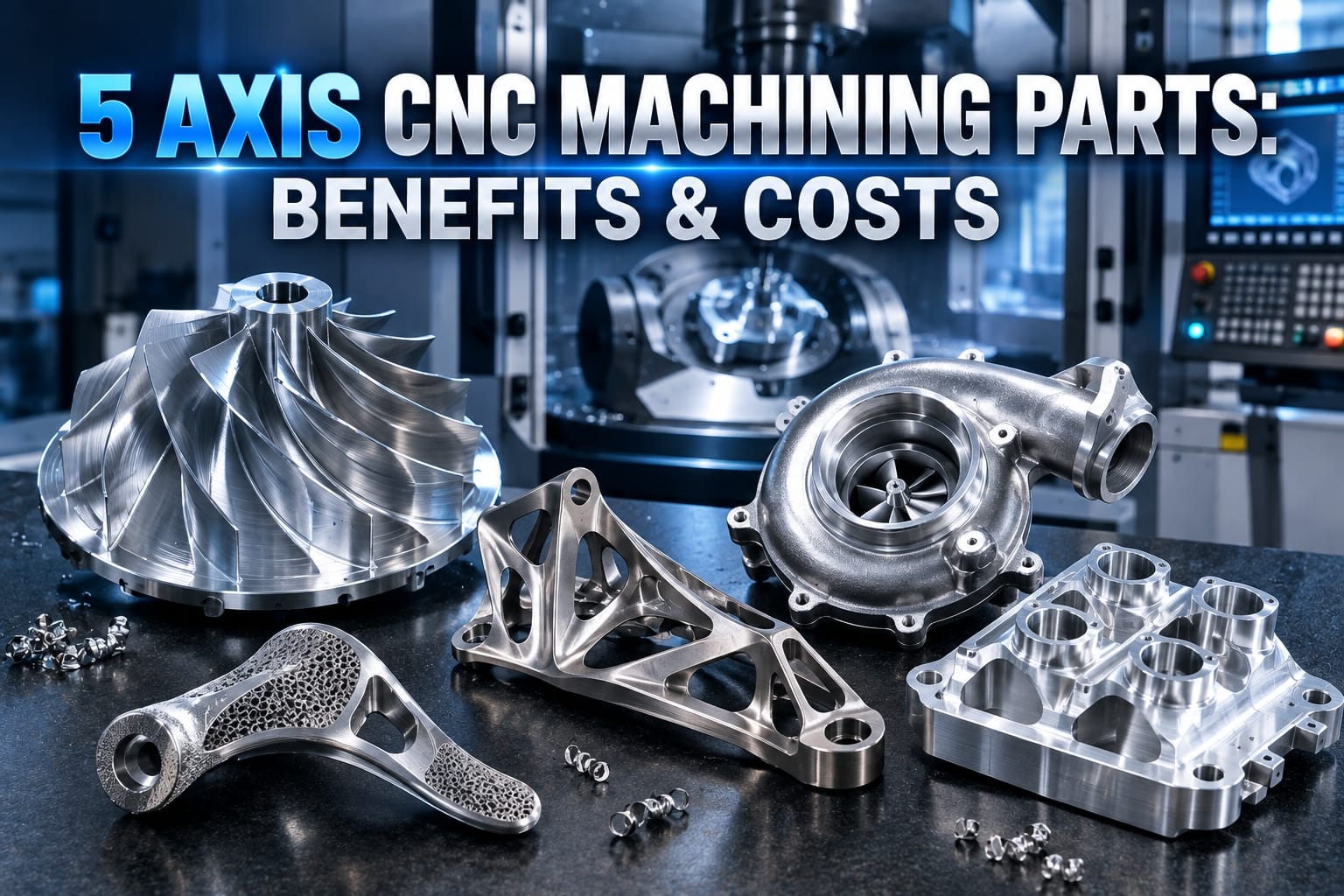
Engineers differentiate between continuous 5-axis machining and 3+2 axis machining (indexed 5-axis). Continuous 5-axis machining maintains simultaneous motion across all five axes during the cutting cycle, which is essential for organic shapes like impellers, turbine blades, and contoured aerospace structural nodes. Indexed 3+2 axis machining positions the part using the rotary axes, locking them into place while the machine executes standard 3-axis milling strokes. This approach significantly shortens tool overhangs, maximizes tool rigidity, and reduces cycle times on multi-sided prismatic parts.
Core Technical Benefits of Sourcing 5-Axis Machining Parts
Transitioning from conventional milling to advanced multi-axis processing yields immediate operational and mechanical advantages. Selecting a capable CNC machining services partner ensures these theoretical advantages translate directly into repeatable, production-grade components.
- Single-Setup Processing (Done-in-One): Machining five sides of a part in a single setup drastically cuts handling time and eliminates machine operator error associated with manual repositioning.
- Elimination of Fixture Stack-Up Errors: Every fixture change introduces positioning variances. Single-setup machining maintains strict reference datums, ensuring tight tolerance stack-ups.
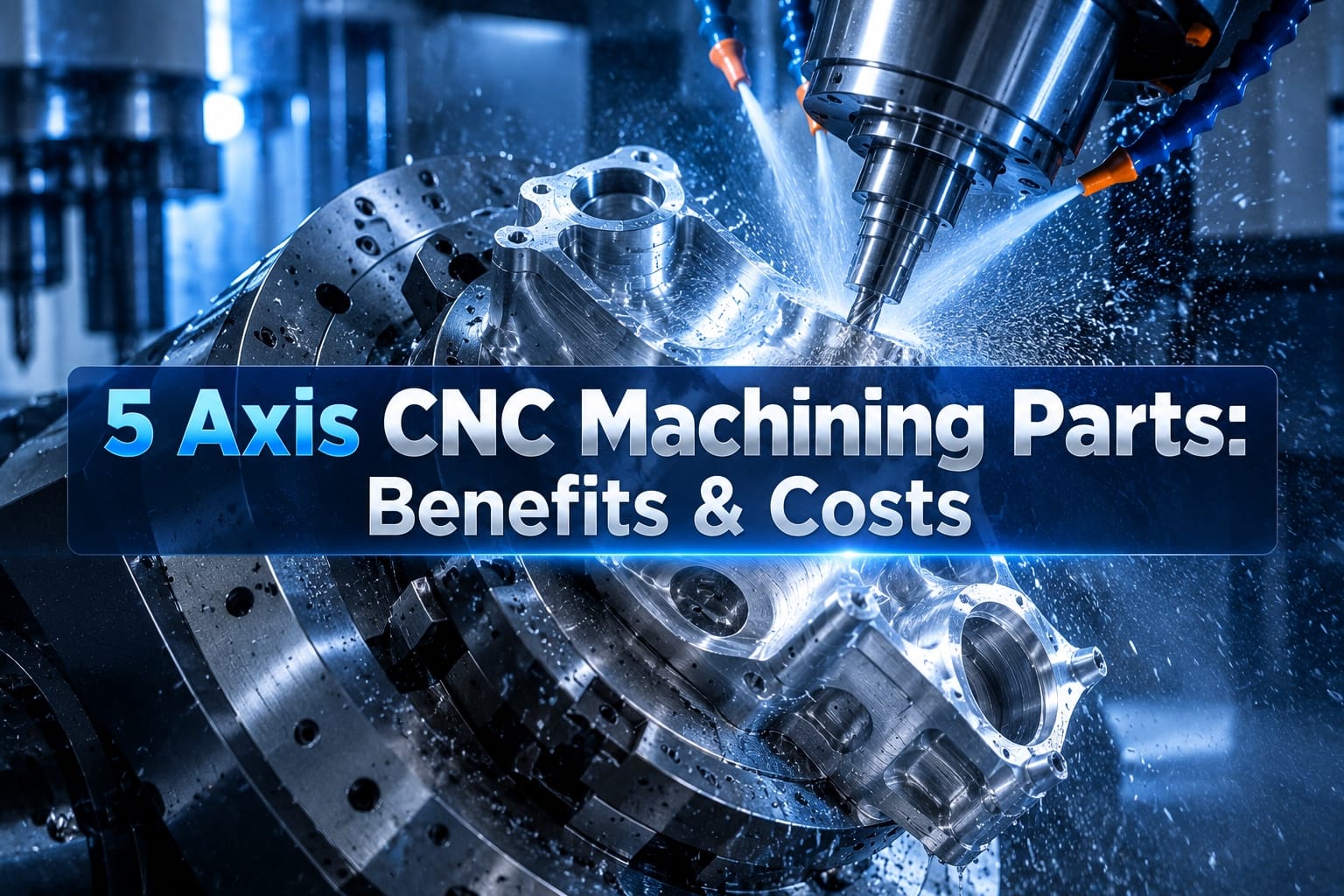
- Shorter Cutting Tools and Superior Surface Finish: Tilting the cutter or workpiece allows the use of shorter, thicker end mills. Reduced tool deflection minimizes chatter, extending tool life and achieving smoother surface finishes (down to Ra 0.8 µm directly off the machine).
- Access to Complex Geometries: Deep cavities, compound angles, and undercuts that are impossible on standard 3-axis equipment become straightforward operations.
To evaluate material choices for your structural or mechanical components, consult our comprehensive guide on CNC machining materials.
| Parameter | Standard 3-Axis Milling | 5-Axis Continuous CNC |
|---|---|---|
| Max Achievable Tolerance | ±0.05 mm (0.002 in) | ±0.005 mm (0.0002 in) |
| Typical Surface Finish (Ra) | 1.6 – 3.2 µm | 0.4 – 0.8 µm |
| Setup Requirements | 3 to 6 distinct setups/fixtures | 1 single setup |
| Tool Aspect Ratio (L/D) | Higher (susceptible to deflection) | Lower (optimized rigidity) |
| Geometric Complexity | Prismatic, planar features | Organic surfaces, impellers, deep pockets |
Industrial Applications & Material Selection
High-precision 5-axis machining serves demanding industrial sectors where failure is not an option. Each industry imposes strict material and dimensional requirements.
Aerospace & Defense
Aerospace components demand high strength-to-weight ratios and structural integrity under high fatigue cycles. Critical parts include turbine impellers, engine manifolds, structural airframe nodes, and wing spars. Common alloys include Titanium 6Al-4V (Grade 5) and aerospace-grade aluminum. Review our specialized aerospace CNC machining capabilities for regulatory and quality details.
Medical Devices
Medical manufacturing mandates biocompatibility, high corrosion resistance, and flawless surface finishes to prevent bacterial adherence. 5-axis machining produces orthopedic implants, bone screws, surgical guides, and enclosure housings for diagnostic equipment using implant-grade Titanium, PEEK, and 316L Stainless Steel.
Automotive & Motorsports
In high-performance automotive manufacturing, strength and lightweighting drive design choices. Multi-axis machining creates turbocharger housings, lightened suspension arms, engine blocks, and custom racing valve trains. Learn more about our automotive machining solutions for low-volume and mass production runs.
| Material Category | Common Grades | Tensile Strength (MPa) | Machinability Rating (%) | Primary Applications |
|---|---|---|---|---|
| Aluminum Alloys | Alloy 6061-T6, 7075-T6 | 310 – 570 | 100% (Base) | Aerospace frames, automotive brackets, electronics housings |
| Stainless Steel | 304, 316L, 17-4 PH | 515 – 1100 | 45% – 60% | Medical tools, fluid power valves, marine hardware |
| Titanium Alloys | Ti-6Al-4V (Grade 5) | 900 – 1000 | 22% | Turbine blades, surgical implants, aerospace fasteners |
| Copper & Brass | C360 Brass, C110 Copper | 220 – 380 | 100% – 180% | Electrical terminals, heat sinks, fluid fittings |
| Engineering Plastics | PEEK, POM (Delrin), PTFE | 70 – 100 | N/A (Soft Material) | Insulators, medical manifolds, low-friction bushings |
Cost Analysis: Key Factors Driving 5-Axis Manufacturing Expenses
Procurement teams often notice higher hourly rates for 5-axis equipment compared to basic 3-axis mills. According to industry research from the Modern Machine Shop Benchmarking Report, 5-axis machining centers represent a significantly higher capital investment, driving hourly shop rates higher. However, the total part cost often favors 5-axis production when factorized across full production runs due to eliminated setup labor and reduced scrap rates.
Key cost drivers include:
- CAM Programming and Simulation Complexity: Generating collision-free toolpaths for 5-axis simultaneous motion requires advanced CAM software (e.g., Mastercam, hyperMILL) and skilled programmer hours. Post-processor validation and full digital twin simulation are mandatory to avoid catastrophic machine collisions.
- Machine Operating Costs: Advanced 5-axis CNC machines feature high-speed spindles, thermal compensation systems, and high-resolution rotary encoders, incurring higher hourly operation overheads.
- Material Removal Rates and Tooling Wear: Hard-to-machine alloys like Inconel or Titanium increase cutting tool consumption. Specialized carbide end mills with custom coatings add to direct consumable costs.
- Quality Assurance & Metrology: Verifying complex spatial surfaces requires 5-axis Coordinate Measuring Machine (CMM) inspection, optical scanning, and detailed GD&T validation reporting.
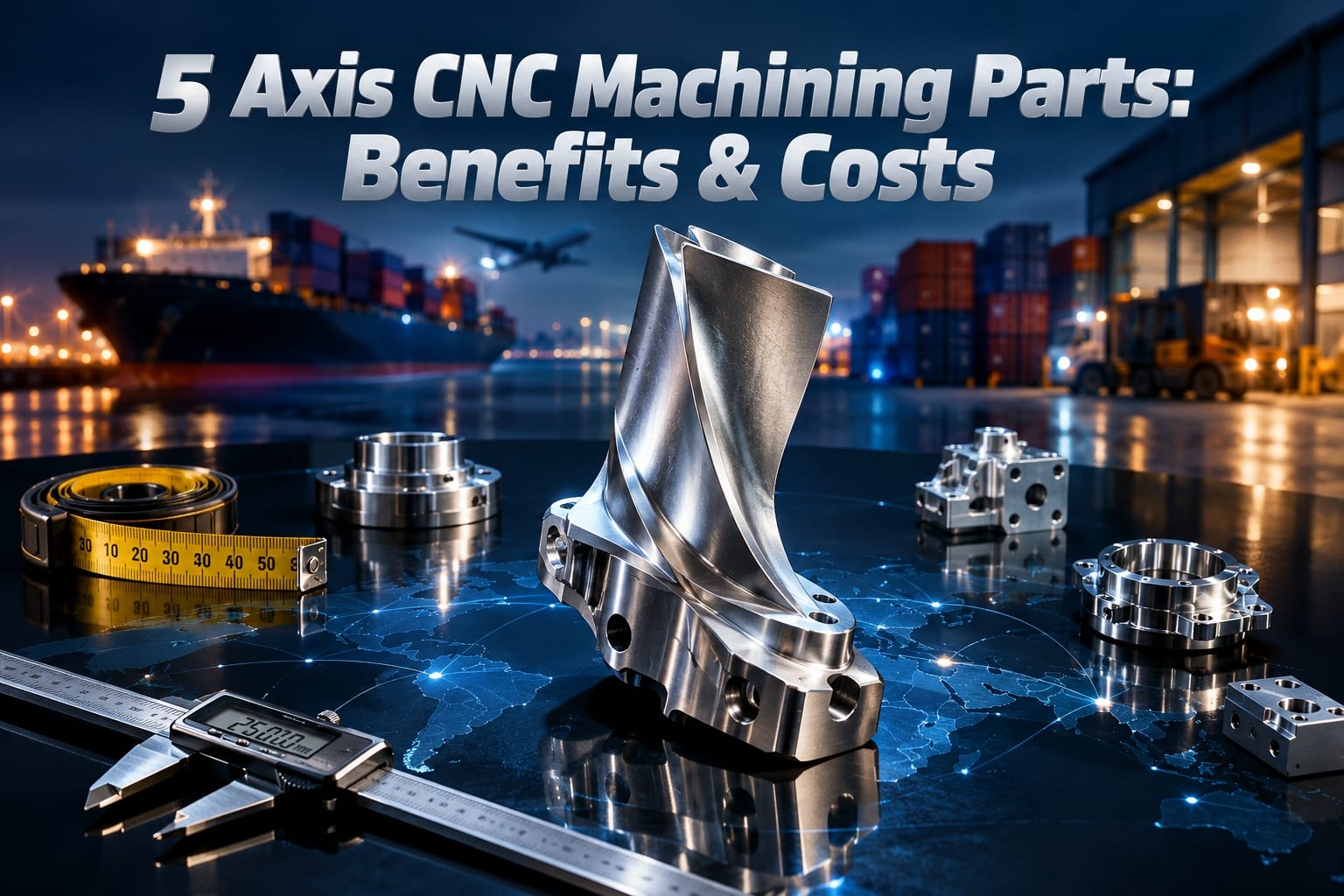
Sourcing teams can mitigate these costs by engaging a certified, high-capacity offshore manufacturer. Leveraging an established offshore vendor allows engineering teams to optimize unit prices while maintaining international quality benchmarks. For immediate RFQ evaluations, engineering teams can directly contact us for a quote.
Design for Manufacturability (DFM) Rules for 5-Axis Parts
To maximize manufacturing efficiency and control unit costs, design engineers should incorporate multi-axis DFM guidelines early in the CAD development cycle.
- Standardize Internal Corner Radii: Avoid sharp internal vertical corners. Design internal radii to match standard tool diameters (e.g., use a 3.175 mm radius for a 6 mm end mill) to prevent tool chatter and allow continuous high-speed cutting.
- Optimize Pocket Depths: Maintain a depth-to-width ratio of less than 4:1 for deep pockets. Deep features require long-reach tooling, increasing tool deflection and surface roughness.
- Provide Direct Fixturing Datums: Include flat parallel surfaces or dedicated tab features in the CAD model to ensure secure workholding without custom, expensive soft jaws.
- Relax Tolerances Where Possible: Apply tight tolerances (e.g., ±0.005 mm) only to critical mating interfaces and bearing journals. Apply standard tolerances (±0.1 mm) to non-functional, free-form surfaces.
How to Qualify a High-Precision CNC Machining Parts Supplier
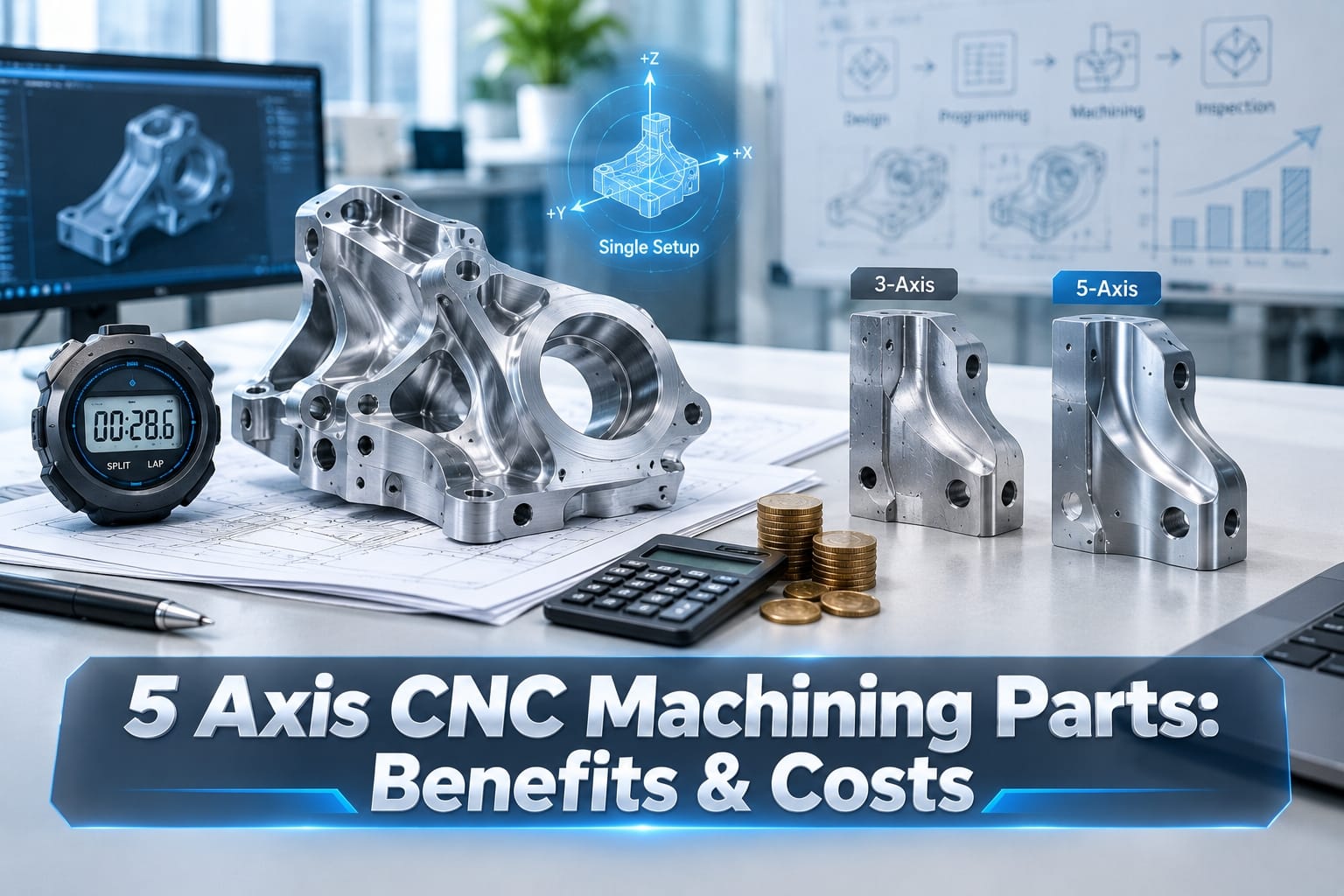
Selecting a capable production vendor requires evaluating technical infrastructure, quality systems, and communication workflows. A qualified supplier must demonstrate rigorous process control from raw material receipt through final dimensional inspection.
Evaluate potential partners using the following criteria:
- Quality Management Certifications: Ensure the facility holds verified ISO 9001:2015 certifications at a minimum, with AS9100D compliance for aerospace programs.
- In-House Metrology Equipment: Confirm the supplier operates temperature-controlled inspection labs equipped with calibrated CMMs, surface roughness testers, and optical comparators.
- DFM Feedback Capability: A reliable engineering partner provides comprehensive DFM analysis prior to cutting metal, identifying potential tool interference, excessive deep pockets, or unachievable tolerances.
To inspect custom component manufacturing capabilities across turned and milled geometries, explore our dedicated CNC turning services.
Conclusion & Next Steps
5-axis CNC machining offers significant precision, structural efficiency, and quality benefits for complex engineering components across critical industries. By consolidating multiple operations into a single setup, procurement managers and engineers minimize fixture stack-up errors while lowering unit costs for demanding geometries. When you need reliable execution and rapid turnarounds, team up with an experienced precision CNC machining parts manufacturer to bring your designs to life.
Ready to streamline your precision supply chain? Request a quote today to receive a comprehensive DFM analysis and competitive pricing on your custom CNC machining requirements.
Frequently Asked Questions (FAQ)
What is the difference between 3+2 axis and continuous 5-axis CNC machining?
In 3+2 axis (indexed) machining, the machine uses two rotary axes to tilt the workpiece into a fixed position, executing standard 3-axis milling operations. Continuous 5-axis machining moves all five axes simultaneously during the cutting pass, making it essential for complex curved surfaces like impellers and aerospace airfoils.
How does 5-axis machining improve dimensional accuracy?
5-axis machining completes parts in a single setup, eliminating multiple workholding fixtures. This removes cumulative datum shift and fixture stack-up errors, allowing true position and geometric profile tolerances down to ±0.005 mm.
Why is 5-axis machining more expensive per hour than 3-axis milling?
5-axis CNC machines involve higher capital investment, advanced CNC controllers, and specialized CAM programming software. However, the higher hourly machine rate is often offset by eliminating multiple fixtures, reducing labor setups, and drastically shortening total cycle time.
What materials are best suited for 5-axis CNC machining?
5-axis machining processes virtually any engineering material, including Aluminum (6061-T6, 7075-T6), Stainless Steels (304, 316L, 17-4 PH), Titanium alloys (Ti-6Al-4V), Brass, Copper, and high-performance engineering plastics like PEEK.