Thermal Conductivity vs. Thermal Expansion in Custom Parts Design
Engineers and sourcing managers face severe challenges when thermal gradients cause dimensional drift, joint fatigue, or heat-induced component failure. Balancing heat transfer with dimensional stability under extreme operating temperatures is critical for aerospace enclosures, EV powertrains, and high-frequency electronics enclosures.
Understanding the Fundamentals: Conductivity vs. Expansion
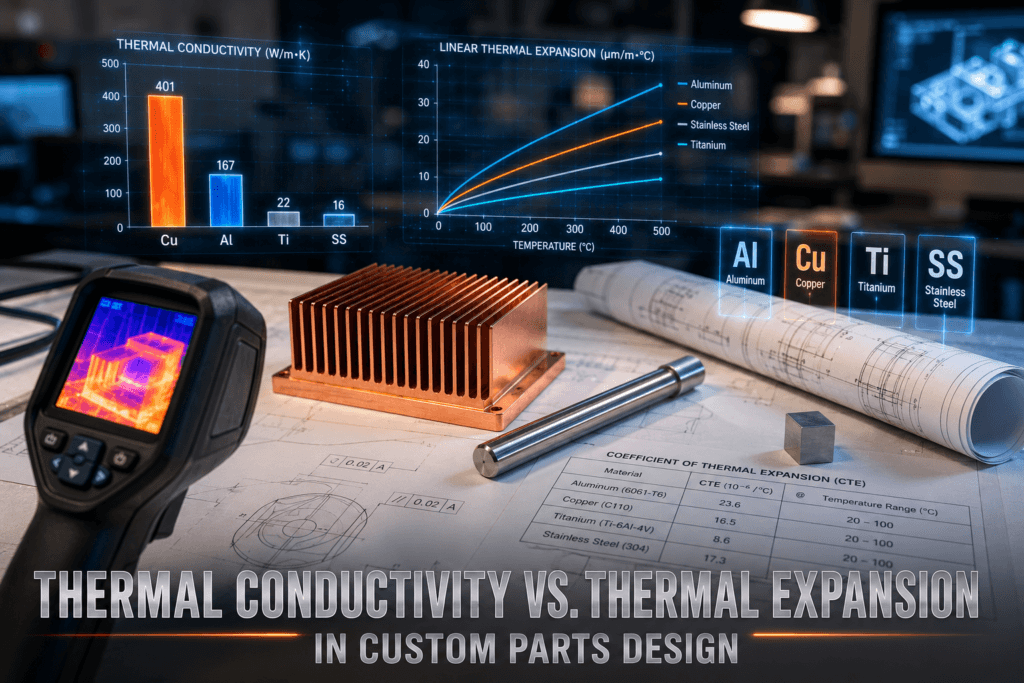
In high-performance custom parts design, thermodynamic management hinges on two fundamental material properties: thermal conductivity (k) and the coefficient of thermal expansion (CTE, or α). Thermal conductivity defines the rate at which heat energy transfers through a solid material via molecular vibration and free electron transport, measured in Watts per meter-Kelvin (W/m·K). High thermal conductivity is vital for components designed to evacuate thermal energy rapidly away from sensitive assemblies, such as semiconductor heat sinks or engine blocks.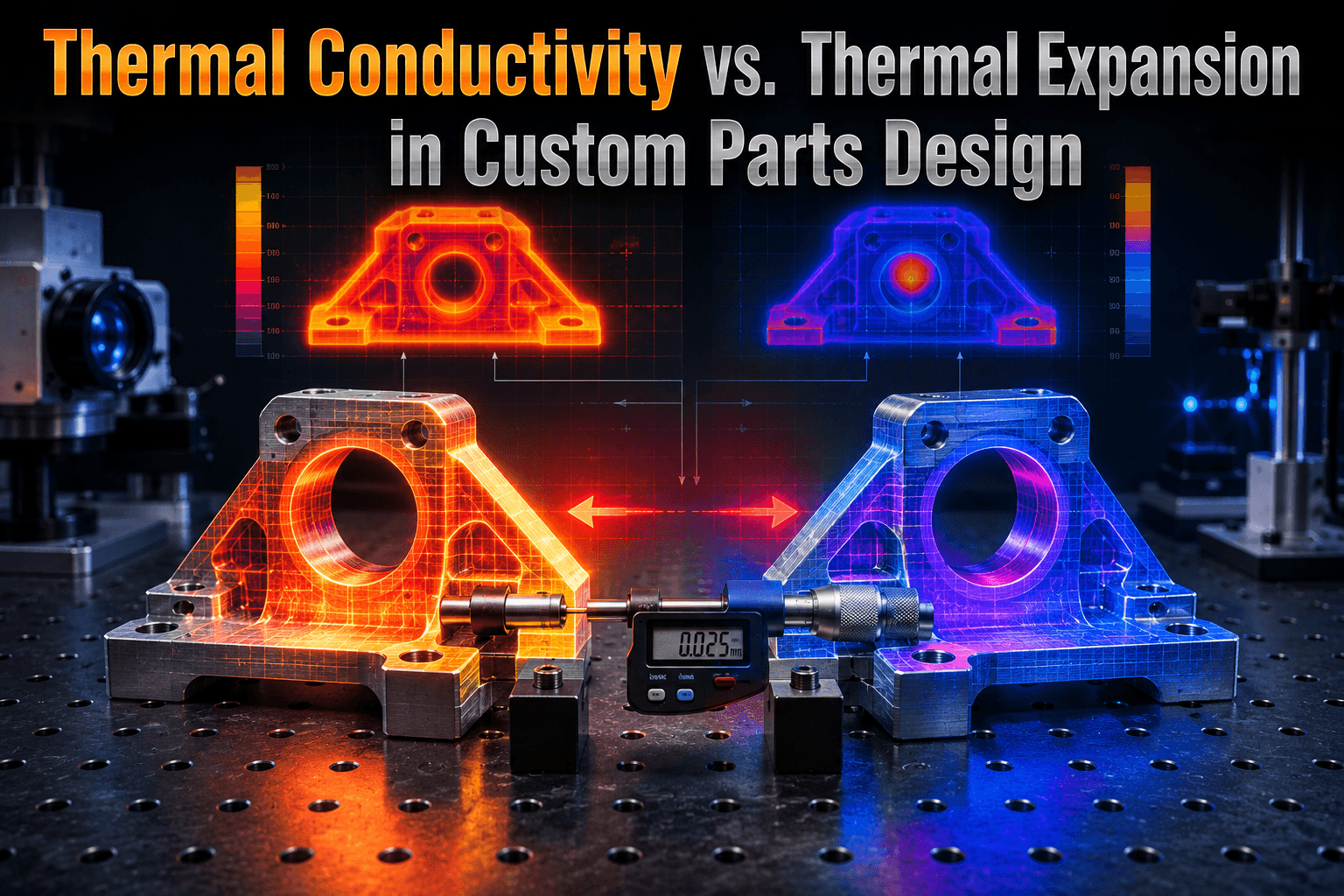
Conversely, thermal expansion describes how the physical dimensions of a material scale up or contract in response to temperature changes, expressed as linear expansion per degree Kelvin ($10^{-6}/\text{K}$ or $\mu\text{m}/\text{m}\cdot^\circ\text{C}$). When a material is subjected to temperature deltas ($\Delta T$), its volumetric and linear boundaries expand. If these boundaries are constrained within a rigid mechanical assembly, massive internal mechanical stress is generated.
Technical Focus: What is Thermal Stress Intensity?
Thermal Stress Intensity ($\sigma_{th}$) represents the internal forces generated within a constrained component when thermal expansion or contraction is physically restricted. It is calculated via the equation:
$$\sigma_{th} = E \cdot \alpha \cdot (T_{final} – T_{initial})$$
Where E is Young’s Modulus ($\text{GPa}$), $\alpha$ is the Coefficient of Thermal Expansion ($10^{-6}/\text{K}$), and $\Delta T$ is the operational temperature differential ($^\circ\text{C}$). If $\sigma_{th}$ exceeds the material’s yield strength ($\sigma_y$), permanent plastic deformation, micro-cracking, or catastrophic assembly failure occurs. Partnering with a skilled CNC machining manufacturer ensures that material selection and geometric tolerances are optimized to prevent thermal stress failures.
The primary design friction occurs because materials exhibiting high thermal conductivity frequently demonstrate moderate-to-high coefficients of thermal expansion. For example, aluminum 6061 conducts heat efficiently ($167\text{ W/m}\cdot\text{K}$) but expands rapidly ($23.0 \times 10^{-6}/\text{K}$). Titanium Grade 5 retains strict dimensional stability ($8.6 \times 10^{-6}/\text{K}$) but acts as a thermal insulator by comparison ($6.7\text{ W/m}\cdot\text{K}$). Sourcing teams must collaborate with a specialized custom CNC machining supplier capable of balancing these material tradeoffs through advanced geometry and high-precision machining setup.
Material Selection Matrix: Balancing Heat Dissipation and Stability
Choosing the correct alloy requires evaluating mechanical properties alongside thermal performance parameters. Sourcingmanagers must select materials that maintain mechanical integrity, structural rigidity, and tight tolerances across operational thermal envelopes.
The following technical matrix details the thermal conductivity, CTE, machinability index, and ideal applications across common engineering alloys and polymers used in high-precision manufacturing:
| Material Designation | Thermal Conductivity (W/m·K) | Coefficient of Thermal Expansion (10⁻⁶/K) | Machinability Index (%) | Primary Application Profile |
|---|---|---|---|---|
| Aluminum 6061-T6 | 167 | 23.0 | 90% | Electronics enclosures, heat sinks, structural brackets |
| Aluminum 7075-T6 | 130 | 23.2 | 80% | Aerospace structural components, high-stress fittings |
| Stainless Steel 316L | 16.3 | 16.0 | 45% | Fluid manifolds, medical housings, corrosive environments |
| Copper C11000 | 388 | 16.9 | 20% | High-power electrical contacts, cold plates, thermal spreaders |
| Titanium Ti-6Al-4V (Gr 5) | 6.7 | 8.6 | 22% | Aerospace turbine components, cryogenic structural mounts |
| PEEK (Unfilled) | 0.25 | 47.0 | 35% | Electrical insulators, chemical processing valves |
Navigating these material dynamics requires deep expertise in raw stock preparation and processing. A reliable CNC machining materials guide aids procurement specialists in selecting alloys that match both thermal envelopes and budget constraints. For instance, while oxygen-free copper provides unbeatable thermal conductivity, its high ductility creates machining challenges like burr formation and tool gumming. Machining copper components requires specialized cutter geometries, high coolant pressures, and refined feed parameters.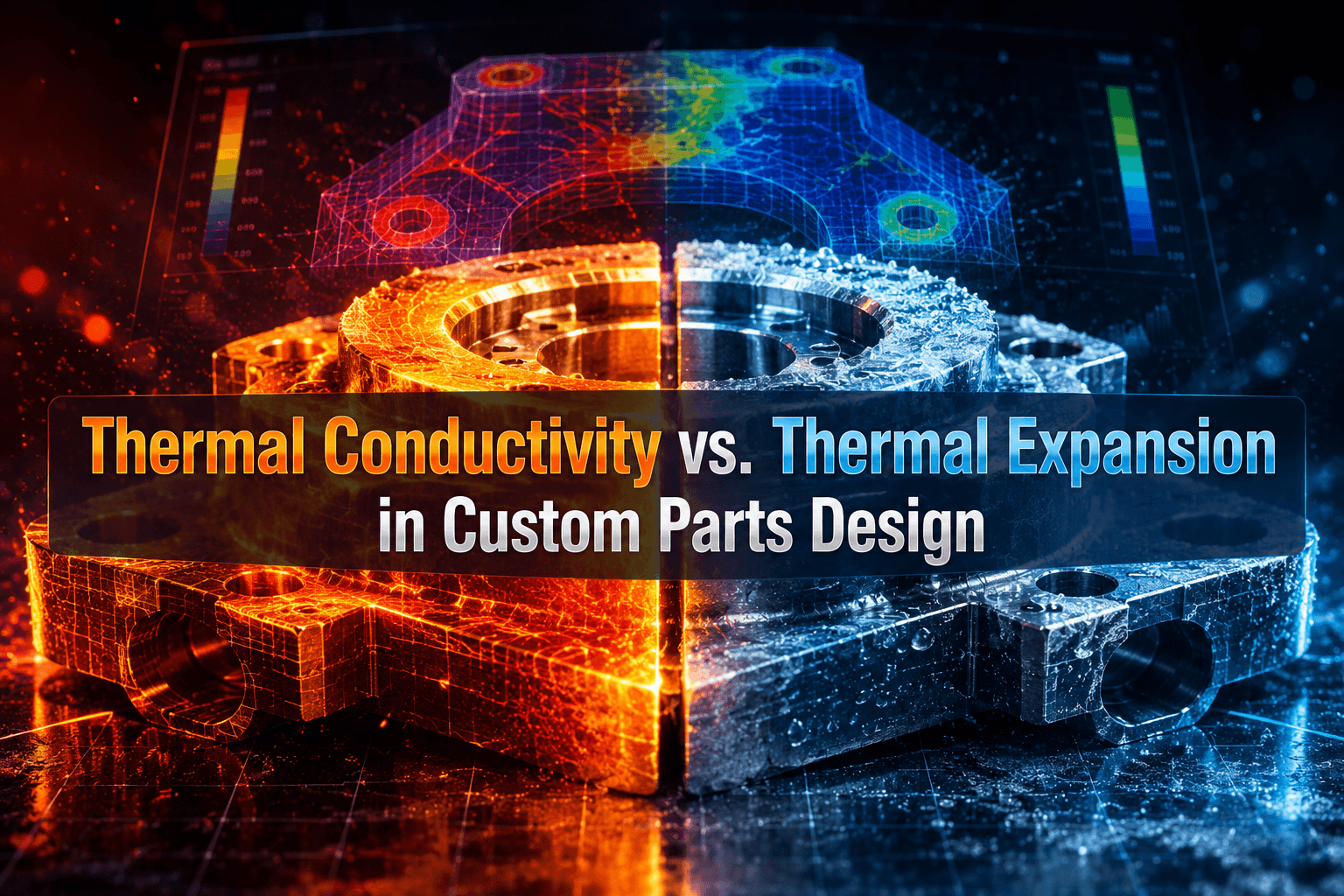
When tight-tolerance thermal assemblies require complex alloy combinations—such as press-fitting stainless steel bushings into an aluminum manifold—designers must account for differential thermal expansion rates. If unmanaged, the aluminum housing expands faster than the steel insert at elevated temperatures, resulting in loss of interference fit, leakage, or alignment drift. Working directly with a qualified CNC machining factory China allows engineering teams to validate joint fits across target temperature ranges using empirical machining data.
Design Strategies to Mitigate Thermal Distortion in Precision Parts
When material substitution alone cannot resolve thermal expansion conflicts, design engineers must implement structural strategies to accommodate thermal movement while maintaining critical functional datums.
1. Thermal Relief Slots and Flexural Kinematic Mounts
Integrating flexural joints or slotted mounting holes into custom machining designs isolates thermal movement. By providing a controlled direction of compliance, expansion stress dissipates harmlessly along flexure axes rather than warping the critical mounting surfaces or causing frame binding.
2. Symmetrical Geometric Heat Distribution
Asymmetrical wall thickness causes uneven heat absorption and non-uniform thermal expansion across the component body. Designing parts with uniform cross-sections, consistent wall radii, and mirrored rib structures ensures heat spreads evenly. This minimizes thermal bowing and keeps precision bores concentric during operation.
3. Optimized Fin Geometries and Fluid Passages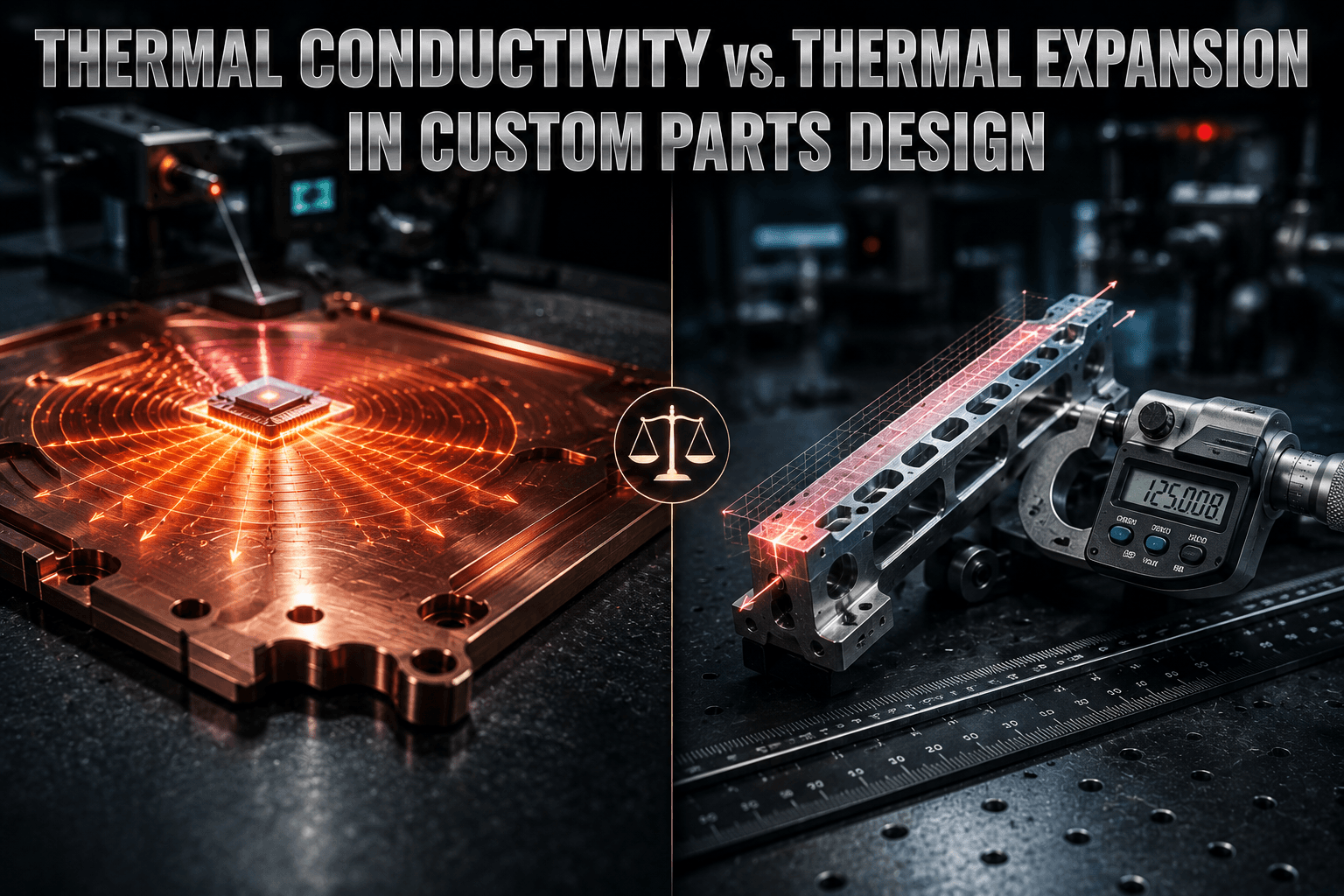
To maximize heat dissipation in dense electronic enclosures without increasing thermal expansion across structural mounting points, design fins with progressive wall taper profiles. Employing advanced multi-axis machining methods allows manufacturers to mill internal coolant channels directly into structural cold plates, ensuring targeted heat removal right at the source.
For complex geometries where thermal relief paths intersect complex structural features, standard 3-axis milling often falls short. Utilizing sophisticated CNC milling services enables the fabrication of compound-angled cooling channels, thin-walled heat fins, and stress-relieving undercut features in a single machine setup.
Executing these advanced designs requires strict adherence to international quality management systems. Sourcing managers should verify that their manufacturing partners operate under certified quality frameworks such as ISO 9001:2015. Certified suppliers implement continuous process monitoring, verifying tool path compensation, thermal growth during cutting, and final part geometry against rigorous engineering standards like ASME Y14.5 (GD&T).
If your project involves tight tolerances operating under variable thermal conditions, consult our engineering team directly via our Contact Us Page to receive a detailed Design for Manufacturability (DFM) analysis.
Manufacturing Challenges: Machining Tight-Tolerance Thermal Components
Fabricating components meant to manage high heat loads presents severe challenges on the shop floor. The physical act of metal cutting generates substantial frictional and shear heat, creating localized thermal expansion inside the workpiece itself during machining operations.
Consider a large 7075-T6 aluminum aerospace plate measuring $1,000\text{ mm}$ in length. During heavy roughing operations, an unmitigated temperature rise of just $10^\circ\text{C}$ causes the aluminum plate to expand linearly by approximately $0.23\text{ mm}$ ($230\mu\text{m}$). If the machinist cuts tight-tolerance features (such as $\pm 0.015\text{ mm}$ hole centers) while the block is hot, the features will shrink out of specification once the component cools to room temperature ($20^\circ\text{C}$).
To overcome heat-induced machining inaccuracies, leading China CNC machining suppliers employ controlled shop floor procedures and advanced machine features:
- Climate-Controlled Shop Environments: Machining centers operate inside environmentally controlled facilities maintained at $20^\circ\text{C} \pm 0.5^\circ\text{C}$ to establish a baseline standard for thermal measurement.
- High-Pressure Through-Spindle Coolant (TSC): Supplying chilled coolant directly through the cutting edge at pressures exceeding $70\text{ bar}$ lowers cutting zone temperatures rapidly, preventing heat soak into the workpiece.
- Real-Time Thermal Compensation Spindles: Modern CNC machine tools integrate thermal sensors embedded within the spindle housing and linear axes. The controller automatically calculates axis growth using dynamic thermal algorithms and adjusts coordinate offsets in real time.
- Multi-Pass Stress-Relieving Protocols: For highly constrained aerospace housings, the machining process is divided into roughing, thermal stabilization/annealing, and final precision finishing passes to release residual internal rolling stresses.
Achieving structural accuracy on round components—such as high-speed motor rotors or stepped thermal sensor sleeves—requires expert turning operations. Utilizing precision CNC turning services equips engineers with ultra-fine surface finishes ($Ra < 0.4\mu\text{m}$) and tight cylindrical tolerances, ensuring uniform radial expansion during high-RPM operation.
Industry Case Studies: Aerospace and Automotive Thermal Applications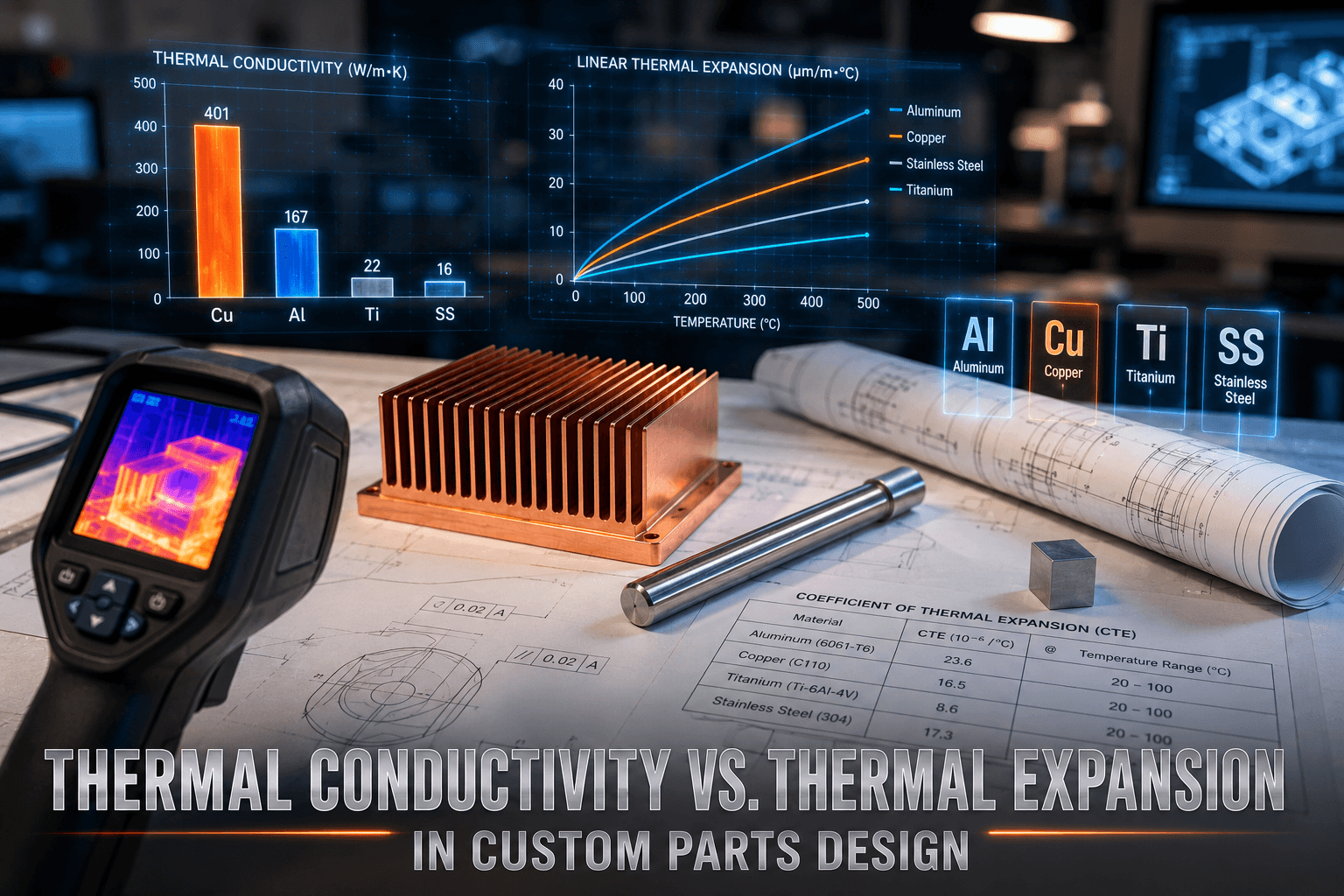
Thermal management requirements vary greatly across different industrial sectors. Examining real-world engineering constraints illustrates how material selection and advanced manufacturing methods intersect.
Aerospace Electronics and Optical Enclosures
Aerospace sensor housings operating in low Earth orbit (LEO) experience rapid temperature swings ranging from $-55^\circ\text{C}$ to $+125^\circ\text{C}$ as satellites cycle into direct sunlight and shadow. Optical mirrors and laser guidance frames housed within these units require near-zero dimensional expansion to maintain beam alignment.
To meet these requirements, aerospace engineers specify custom low-expansion alloys like Invar 36 ($\text{CTE } 1.2 \times 10^{-6}/\text{K}$) or titanium grade 5 structural frames combined with isolated copper heat pipes. Machining Invar requires high rigidity, sharp carbide tooling, and low cutting speeds to overcome work-hardening properties. Partnering with a skilled aerospace CNC machining expert ensures tight-tolerance optical datums remain stable under severe thermal shock cycles.
Automotive Power Inverters and Battery Cold Plates
Electric vehicle (EV) power electronics convert high-voltage DC power into AC power, generating substantial heat across small silicon carbide (SiC) MOSFET chips. Cold plate manifolds must rapidly absorb and transfer this heat energy into circulating liquid coolant without leaking or deforming under internal fluid pressure.
Automotive OEMs rely on high-volume automotive machining solutions to manufacture lightweight, high-conductivity aluminum 6061 or 3000-series cold plates. Advanced 5-axis machining mills dense micro-channel pin arrays into cold plates, expanding surface contact area by up to 300% without increasing the footprint. The finished plates are precision-lapped to flatnesses within $0.012\text{ mm}$ across the chip interface, ensuring minimum thermal contact resistance.
Whether you require fast-turnaround CNC prototype machining to validate thermal models or stable low volume CNC machining runs for specialized machinery, matching part geometry with process control is essential.
Ready to optimize your next thermal design? Submit your CAD models and drawing specifications to our engineering team today through our Contact Us Page for a comprehensive manufacturability review and competitive quotation within 24 hours.
Frequently Asked Questions (FAQ)
How do you calculate thermal stress in custom CNC machined components?
Thermal stress ($\sigma_{th}$) is calculated using the formula $\sigma_{th} = E \cdot \alpha \cdot \Delta T$, where $E$ is Young’s Modulus ($\text{GPa}$), $\alpha$ is the Coefficient of Thermal Expansion ($10^{-6}/\text{K}$), and $\Delta T$ is the operating temperature delta ($^\circ\text{C}$). If the component is fully constrained, exceeding the material’s yield strength leads to permanent deformation, joint loosening, or structural failure.
Why is 5-axis CNC machining preferred for high-thermal-gradient aerospace parts?
5-axis CNC machining allows complex organic heat dissipation fins, internal coolant passages, and angled strain-relief features to be produced in a single machine setup. This eliminates multi-setup positioning errors, preserving geometric tolerances critical for parts exposed to extreme thermal cycles.
Can thermal expansion be compensated during the CNC machining process?
Yes. A specialized precision precision CNC machining factory China utilizes climate-controlled shop floors ($20^\circ\text{C} \pm 0.5^\circ\text{C}$), real-time thermal compensation software in machine controllers, and high-pressure coolant delivery systems to counteract thermal drift during long machining passes.
What surface finishes improve heat dissipation in custom machined heat sinks?
Black anodizing on aluminum components increases surface emissivity ($\epsilon$) from approximately 0.05 (bare machined aluminum) to over 0.85. This enhancement significantly increases radiative heat transfer alongside conductive heat dissipation.
Conclusion
Balancing thermal conductivity and thermal expansion in custom parts design requires careful material selection, intelligent structural geometry, and rigorous CNC machining process controls. Managing thermal stress and dimensional expansion ensures long-term performance across demanding aerospace, automotive, and electronics applications.
Boraco Machining brings over a decade of precision manufacturing expertise, combining climate-controlled production facilities, 5-axis CNC machinery, and ISO 9001:2015 quality assurance to deliver defect-free components. Contact our expert engineering team today through our Contact Us Page to request an instant quote and technical DFM evaluation for your thermal management parts.
Reference
[1] Pelleg, J. (2012). Mechanical Properties of Materials. Springer. https://doi.org/10.1007/978-94-007-4342-7
[2] ASM International. (1990). ASM Handbook, Volume 1: Properties and Selection: Irons, Steels, and High-Performance Alloys. ASM International. https://doi.org/10.31399/asm.hb.v01.9781627081610