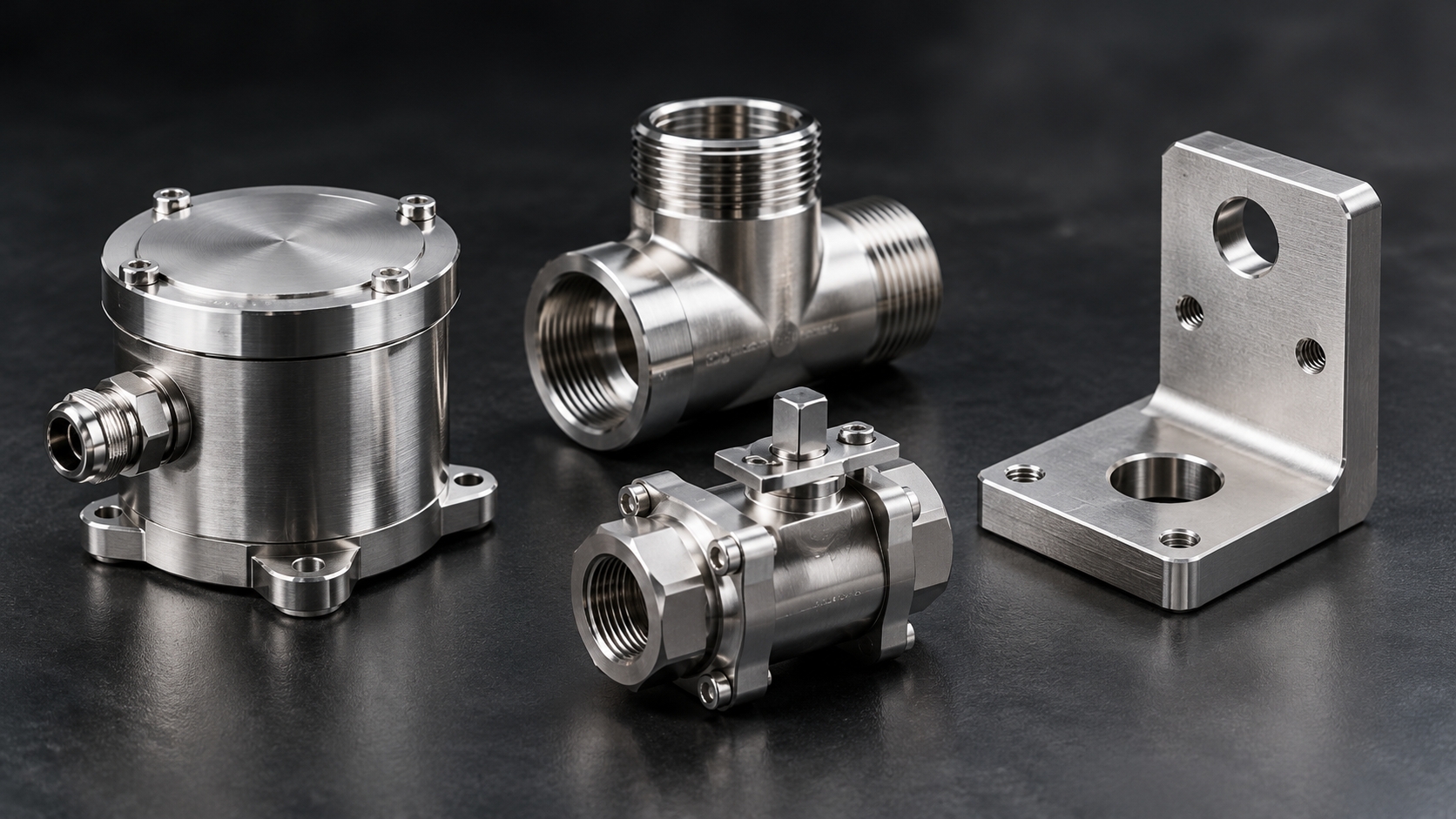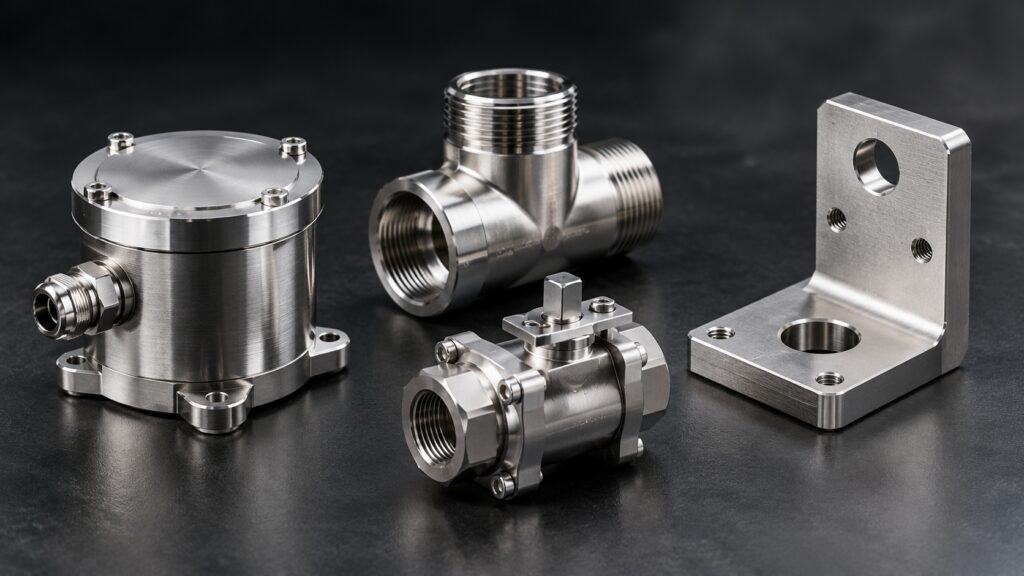
304 stainless steel is the most widely used austenitic stainless alloy in the world — roughly 18% chromium, 8% nickel, and no molybdenum. It machines cleanly on standard CNC mills and lathes, resists atmospheric and freshwater corrosion, polishes and anodizes well, and costs about 40–60% less than 316. For brackets, fittings, enclosures, food-contact hardware, and general-purpose machined components, 304 stainless steel is the default choice engineers reach for when carbon steel won’t survive the environment.
Send us your drawing for a free DFM quote on 304 stainless steel parts — response within 12 hours →
But “default” doesn’t mean “always right.” 304 work-hardens aggressively, it pitts in chloride environments, and it’s one of the most commonly faked grades on the market (201 stainless passed off as 304). This guide covers what 304 actually is, how it machines on CNC, when you should step up to 316, what tolerances and finishes to expect, and how to buy it without getting burned.
Key Takeaways
- 304 = 18% Cr / 8% Ni / no Mo. It’s the baseline austenitic stainless — great for indoor, freshwater, and mild-corrosion environments; not for salt spray, coastal, or chloride exposure.
- It machines, but it fights back. 304 work-hardens 3–4× faster than carbon steel; the fix is positive chip load, sharp coated carbide tooling, and never letting the cutter dwell.
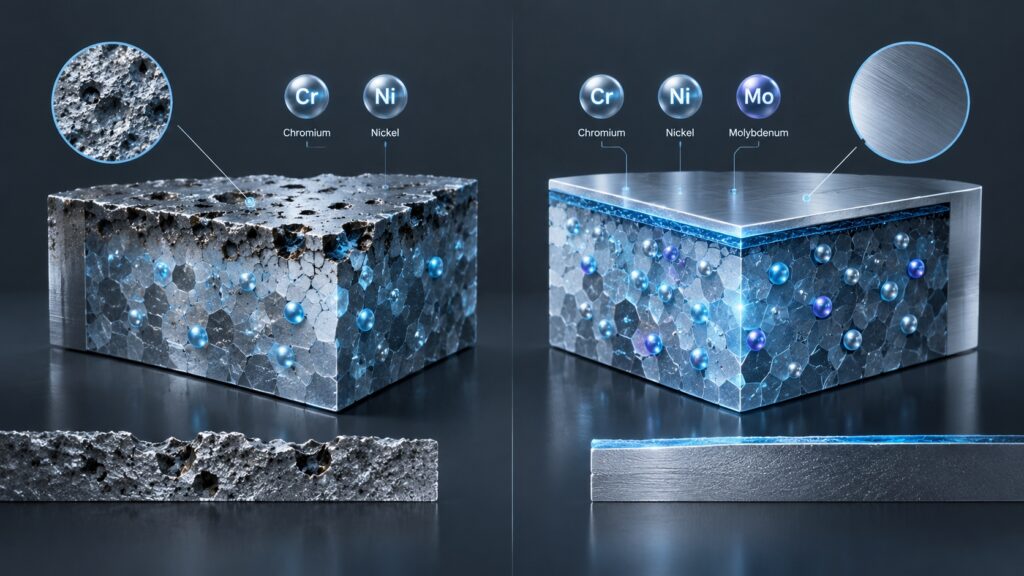
- 316 is 304 plus 2–3% molybdenum. That single element roughly doubles pitting resistance (PRE 18 → 26) and adds 30–60% to the material bill.
- Typical CNC tolerance on 304 is ±0.02–0.05 mm, with critical features at ±0.01 mm; surface finishes of Ra 0.8 µm are routine, Ra 0.4 µm with polishing.
- Boraco CNC-machines 304, 304L, and 316 parts in Dongguan, with material certificates, PMI (spectral) verification on every batch, and in-house finishing.
What Is 304 Stainless Steel?
304 stainless steel is an austenitic alloy — its microstructure is face-centered cubic, which makes it non-magnetic (or only weakly magnetic after cold work), tough, and formable. It cannot be hardened by heat treatment; the only way to strengthen it is cold working.
The standard composition band per ASTM A240 / AISI 304:
| Element | Typical % |
|---|---|
| Chromium (Cr) | 18.0–20.0% |
| Nickel (Ni) | 8.0–10.5% |
| Manganese | ≤ 2.0% |
| Silicon | ≤ 1.0% |
| Carbon | ≤ 0.08% (0.03% for 304L) |
| Iron | Balance |
| Molybdenum | None |
The chromium forms a self-healing passive chromium-oxide film on the surface (see Wikipedia: Stainless steel for the broader metallurgy) — that’s what makes it “stainless.” As long as oxygen can reach the surface, the film repairs itself. In oxygen-starved crevices or high-chloride environments, the film breaks down and pitting starts.
Two common variants you’ll see on drawings:
- 304 (1.4301): the standard grade, carbon ≤ 0.08%.
- 304L (1.4306): low-carbon version (≤ 0.03%), used when the part is welded after machining. Lower carbon = less carbide precipitation in the heat-affected zone = less intergranular corrosion.
304 vs 316 Stainless Steel: Which Should You Choose?
To the naked eye they’re identical. The difference is one element: molybdenum.
| Factor | 304 | 316 |
|---|---|---|
| Chromium | 18–20% | 16–18% |
| Nickel | 8–10.5% | 10–14% |
| Molybdenum | None | 2–3% |
| PRE* (pitting resistance) | ~18 | ~26 |
| Salt / chloride resistance | Poor (pits in < 1 year coastal) | Good |
| Price vs carbon steel | ~3× | ~4.5–5× |
| Machinability | Easier (lower cutting forces) | Slightly harder, stringier chips |
| Typical use | Indoor, food, pharma enclosures, brackets | Marine, coastal, medical implants, chemical |
* PRE = Chromium + 3.3× Molybdenum + 16× Nitrogen. Higher = better pitting resistance.
Choose 304 when:
- The part is indoors, in a dry or mildly humid environment.
- It contacts freshwater, food, or standard cleaning chemicals.
- Weight, cost, and cosmetic finish matter more than marine-grade corrosion.
- It’s a bracket, fastener, fitting, sensor housing, or machinery component.
Step up to 316 when:
- The part sees salt spray, coastal air, pool chemicals, or de-icing salts.
- It contacts bodily fluids, medical environments, or food brines.
- It’s outdoors for more than a year in a humid or coastal climate.
- The design calls out ASTM A276 Type 316L explicitly.
A European customer once machined a sensor housing in 304 for a coastal packaging line. Six months in, pitting appeared around the mounting holes. The root cause: weekly washdown with chlorine-based sanitizer. We re-ran the same geometry in 316L — same tooling, same cycle time, 35% higher material cost, zero corrosion three years on. On chloride exposure, 316 isn’t a luxury; it’s cheaper than a recall.
You can browse our full CNC machining materials page for the complete alloy list, or see our dedicated steel page for stainless-specific capacity.
Machining 304 on CNC: What Engineers Need to Know
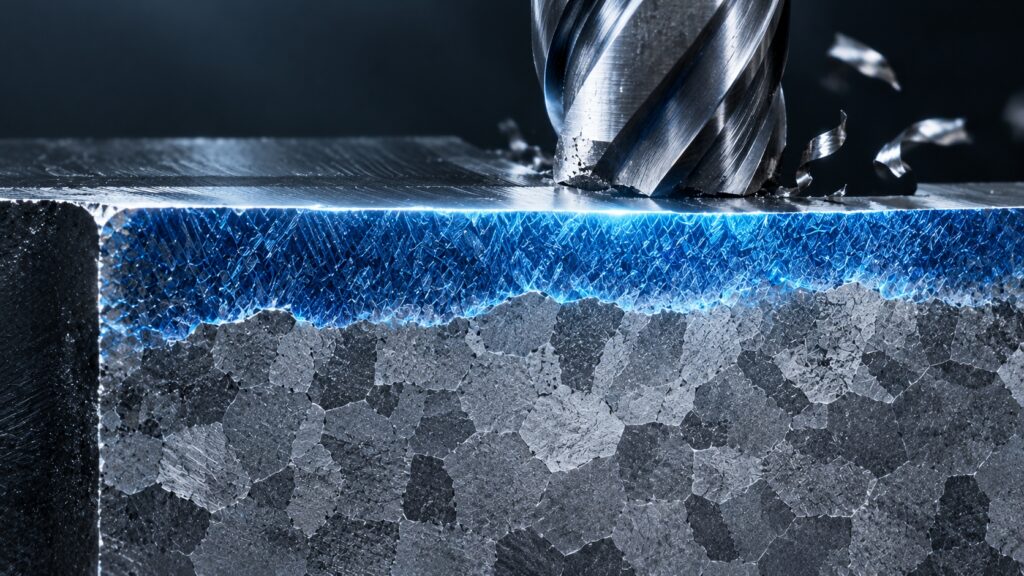
304 machines — but unlike aluminum or mild steel, it fights back. Two physical problems drive every shop-floor decision:
1. Work hardening
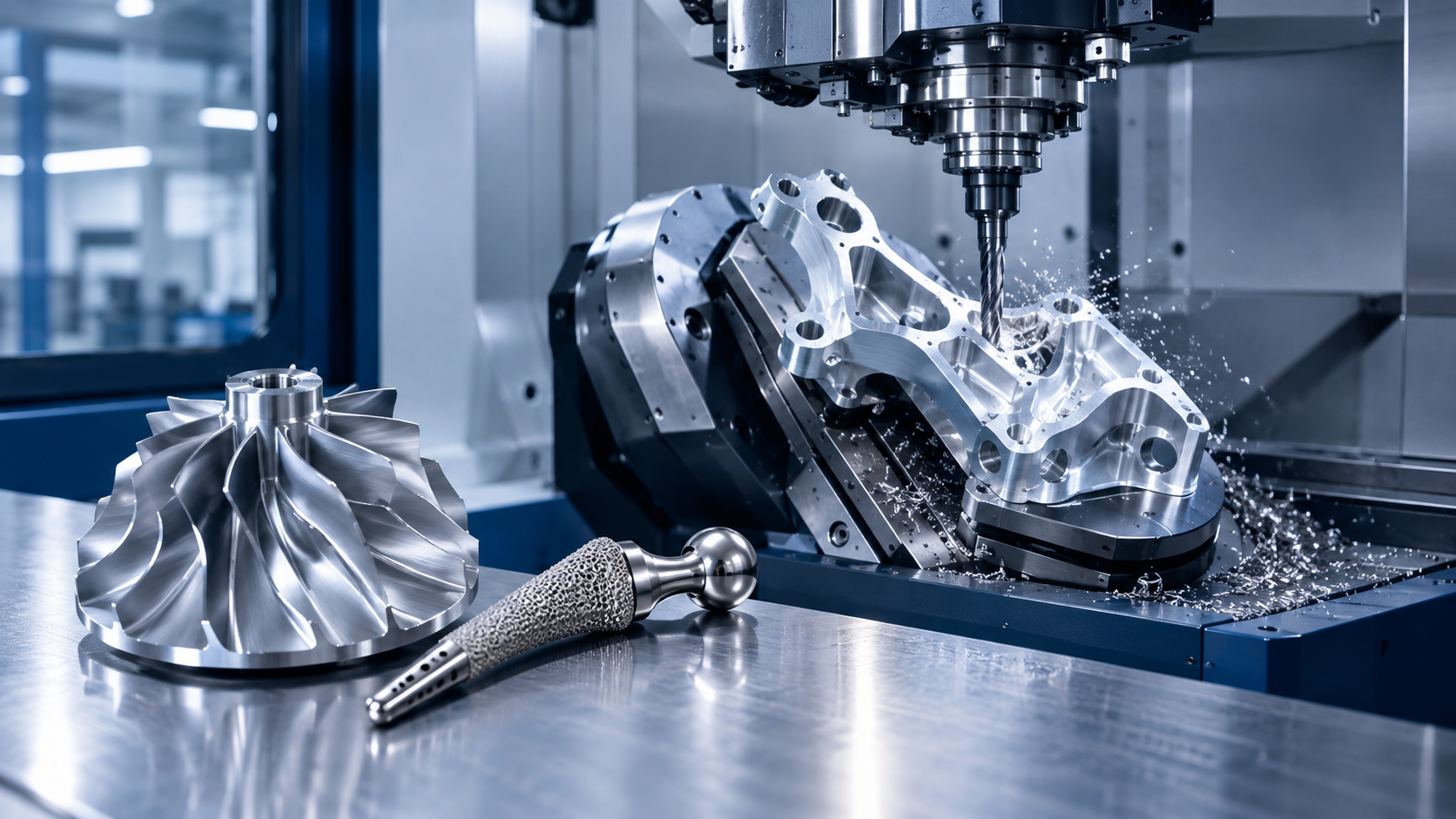
Austenitic stainless steel work-hardens at roughly 3–4× the rate of 1045 carbon steel. The plastic strain at the cutting edge transforms a thin layer of austenite into hard martensite. Surface hardness can jump from ~150 HV in the annealed bar to over 400 HV in the layer you just cut.
The practical consequences:
- Never dwell the cutter. A paused tool on a freshly cut surface rubs against the hardened layer and accelerates flank wear.
- Keep chip load positive. Roughing chip load should stay above
0.0008″ per tooth (0.02 mm). Skimming at light feeds is the #1 cause of premature tool failure on 304. - Take cuts deep enough to stay below the hardened layer. A 0.1 mm finishing pass over a surface that’s already work-hardened from the previous roughing pass is a recipe for chatter and tool breakage.
2. Heat and chip evacuation
304’s thermal conductivity is only ~16 W/m·K (about a third of mild steel). Roughly 70–80% of the cutting heat stays in the tool and the workpiece, not in the chip. Combined with long, stringy chips that wrap around the cutter, this means:
- Coated carbide tooling is mandatory. TiCN or TiAlN-coated inserts handle the heat; HSS tools will wear out in minutes.
- High-pressure coolant through the spindle breaks the chip and cools the cutting zone. Flood coolant alone is marginal on deep cuts.
- Rigid setups. Long tool overhang = chatter = poor surface finish and accelerated wear.
A Midwest job shop we partnered with once tried to finish a 304 bracket on a manual mill with HSS endmills. The first piece came out okay; by piece eight, the cutter was rubbing, the surface was work-hardened, and the tolerance drifted by 0.08 mm. We moved the job to a CNC mill with coated carbide and through-spindle coolant — same geometry, ±0.02 mm held across 500 pieces.
If you’re sourcing turned parts, see our CNC turning services page; for prismatic work, our CNC milling services page.
Tolerances, Surface Finish, and Typical Applications
Realistic expectations on 304 from a competent CNC shop:
| Dimension | Typical | Best-in-class (with CMM) |
|---|---|---|
| Standard tolerance | ±0.05 mm | ±0.02 mm |
| Critical feature (bore, locating hole) | ±0.01–0.02 mm | ±0.005 mm |
| Surface finish as-machined | Ra 1.6–3.2 µm | Ra 0.8 µm |
| After bead blast / polish | Ra 0.4–0.8 µm | Ra 0.2 µm (mirror polish) |
| Threads | 6g / 6H class | 4H5G with precision taps |
Common 304 CNC-machined parts:
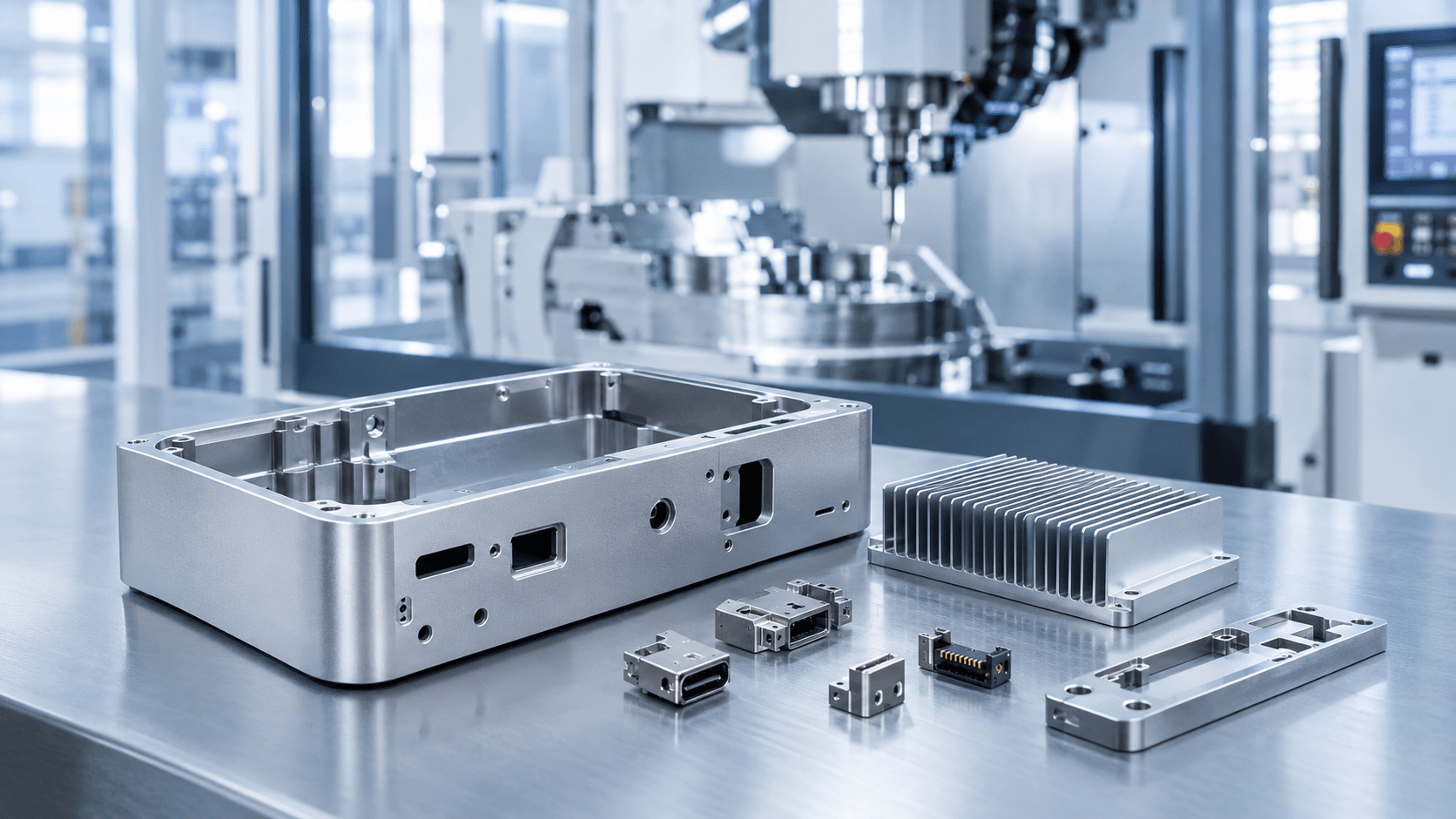
- Sensor housings, instrument enclosures, and junction boxes
- Food and beverage fittings, pump components, valve bodies
- Pharmaceutical machinery brackets and guides
- Architectural trim, handles, and decorative hardware
- Automotive trim brackets and EV battery contactors
- Aerospace interior components (non-primary structure)
After machining, 304 responds well to finishing services: bead blast for a uniform matte, electropolish for food-contact and cleanroom use, passivation to restore the oxide layer, and powder coat or plating when you need a color.
304 vs Other Grades: A Quick Selector
If 304 isn’t quite right, here’s how the common alternatives compare:
| Grade | Type | When to reach for it |
|---|---|---|
| 201 | Low-Ni austenitic | Cheaper knock-off — NOT for precision or outdoor use. Often faked as 304. |
| 304 / 304L | Austenitic | The default. Indoor, food, mild corrosion. |
| 316 / 316L | Austenitic + Mo | Salt, coastal, medical, chemical exposure. |
| 430 | Ferritic | Magnetic, cheaper, limited formability. Decorative trim only. |
| 17-4 PH (630) | Precipitation hardening | High strength + corrosion — shafts, pins, structural. |
| 2205 | Duplex | Twice the strength of 304, better chloride resistance. Heavy marine/process. |
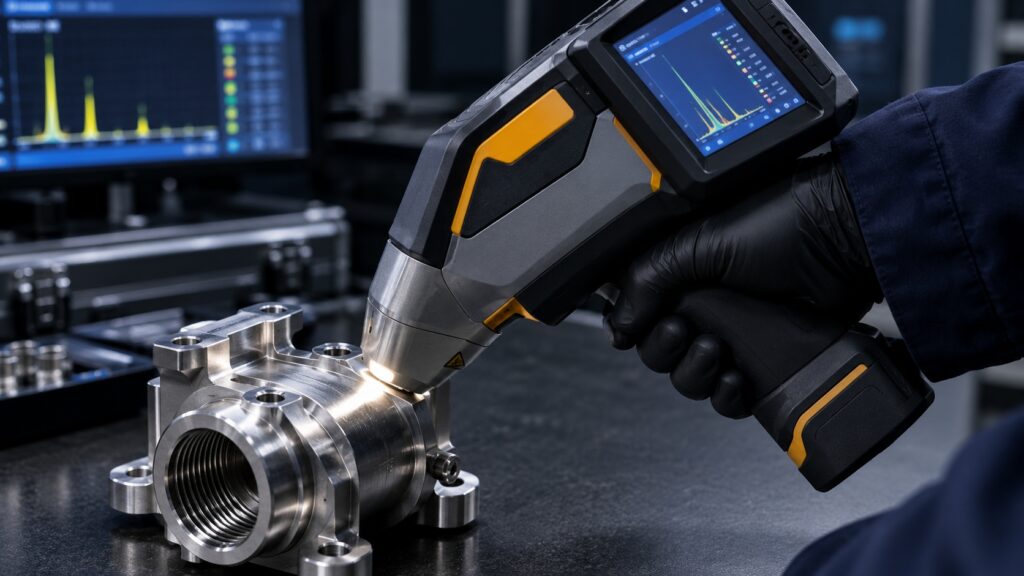
A note on 201: it looks like 304, polishes like 304, and costs 20% less. But it has ~4.5% Ni (vs 8%) and higher manganese, so it rusts in humid air and work-hardens even worse. If a Chinese supplier quotes 304 at 15% below market, PMI (spectral) test the first batch. We verify every heat with a handheld XRF spectrometer before it hits the machine.
Cost: Why 304 Is the Sweet Spot
Material cost is only one line. Total cost to deliver a finished 304 part:
| Cost factor | 304 | 316 | Aluminum 6061 | Carbon steel 1045 |
|---|---|---|---|---|
| Raw bar cost (relative) | 3× | 4.5× | 1× | 0.6× |
| Machining time | 1.0× baseline | 1.1× | 0.6× | 0.7× |
| Tool wear | High (work hardening) | Higher | Low | Low |
| Surface finish effort | Moderate | Moderate | Low | Low |
| Weldability | Good (304L better) | Good (316L better) | Good | Excellent |
| Total relative part cost | ~1.5–2× aluminum | ~2–2.5× aluminum | 1× | ~0.8× aluminum |
For low and medium volumes (1–10,000 pieces), 304 hits the sweet spot: stainless corrosion performance at roughly half the premium of 316. Above that volume, if corrosion isn’t the driver, stamped or cast parts in 304 become cheaper per unit — but that’s a tooling conversation, not a machining one.
Sourcing 304 CNC Parts from China: What to Verify
Chinese shops can machine excellent 304 parts — but the market also has a real quality spread. Four checks before you commit:
- Material certificates (Mill Test Reports, EN 10204 3.1). Every batch should ship with a heat number you can trace. No MTR = no deal.
- PMI / XRF verification. Even with an MTR, a handheld spectral check catches 201 passed off as 304 in seconds. We run it on first article and spot-check production.
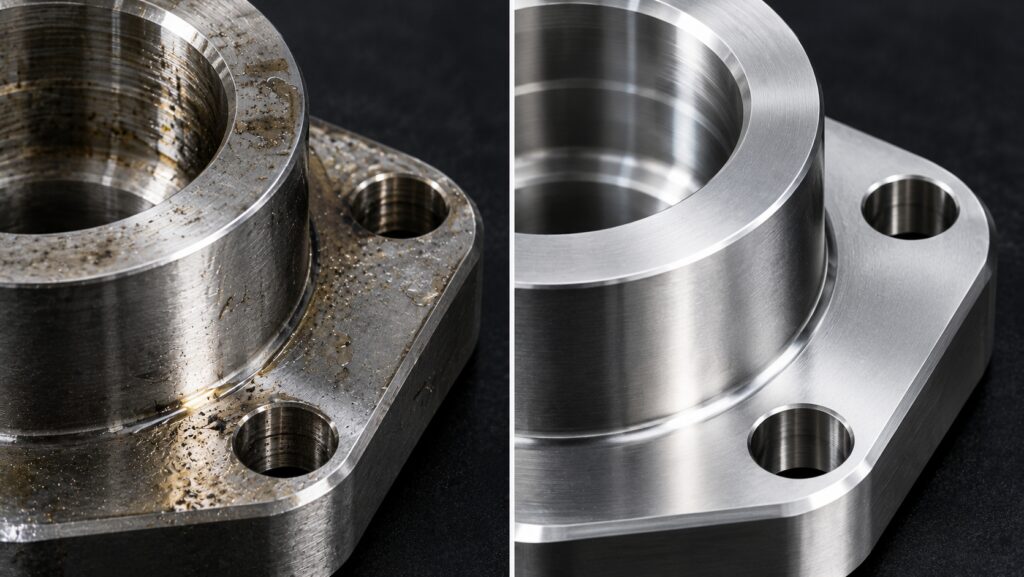
- Passivation after machining. Machining oils and free iron on the surface break down the passive layer. A citric-acid or nitric-acid passivation step after machining is standard for food and medical parts — ask if it’s included.
- DFM response time. A serious shop flags that your internal radius is too small, your tolerance is over-specified, or that 304L is the right call for a welded assembly — before you pay.
We’ve been machining stainless for export customers in North America and Europe for 13 years, out of our 2,000 sqm CNC machining factory in Dongguan. No MOQ, prototype to mass production under one roof.
Common Mistakes Buyers Make
- Specifying 316 “just in case” on indoor parts. You pay 35–50% more for no performance benefit.
- Specifying 304 for coastal or washdown environments. Pitting shows up 6–18 months later, not at inspection.
- Ignoring the work-hardening issue in the RFQ. Shops that quote 304 at carbon-steel rates are either underestimating tool wear or planning to buy cheap tooling.
- Skipping passivation. As-machined 304 looks great and rusts in salt spray because free iron from the tool sits on the surface.
- Accepting no MTR / no PMI. On 304, the cheapest quote is very often 201 in disguise.
Frequently Asked Questions
Is 304 stainless steel magnetic?
Fully annealed 304 is essentially non-magnetic. After machining, bending, or cold drawing, a small martensitic phase forms and the material becomes weakly magnetic. That’s normal — don’t reject parts for “being magnetic.”
Can 304 stainless steel be welded?
Yes, but choose 304L for welded assemblies. The low-carbon version avoids carbide precipitation in the heat-affected zone, which prevents intergranular corrosion. Post-weld passivation is recommended.
What tolerance can you hold on CNC-machined 304?
Standard tolerance is ±0.02–0.05 mm; critical bores and locating holes routinely hold ±0.01–0.02 mm, verified by CMM. Ultra-precision work reaches ±0.005 mm on specific features.
Is 304 stainless steel food-safe?
Yes. 304 (and 304L) is the standard material for food and beverage equipment, kitchen hardware, and pharmaceutical machinery — as long as it’s passivated after machining.
How does 304 compare to aluminum for CNC parts?
Aluminum is cheaper and machines faster, but 304 is stiffer, harder, more scratch-resistant, and far more corrosion-resistant. Choose aluminum for weight and cost; choose 304 for durability, food contact, and outdoor exposure.
About Boraco
Boraco has been precision CNC machining in Dongguan since 2013. We machine 304, 304L, 316, 316L, 17-4 PH, 2205, and other stainless grades in-house, along with aluminum, titanium, brass, copper, and engineering plastics. Every batch ships with material certificates, optional CMM inspection reports, and 12-hour DFM feedback.
Read more about us on the about page, or browse our CNC machining service overview.
Send your CAD for a free DFM quote — response within 12 hours →