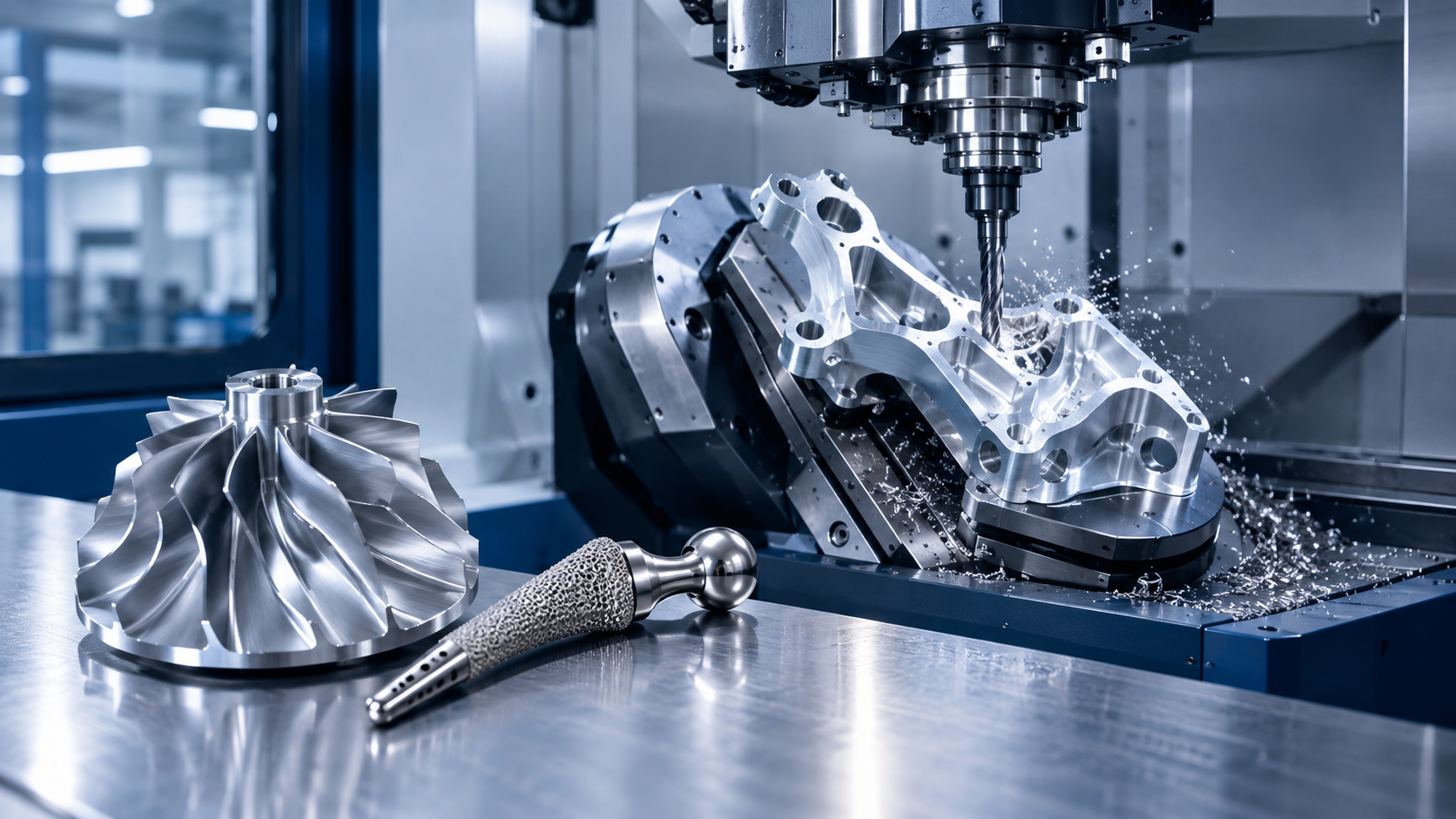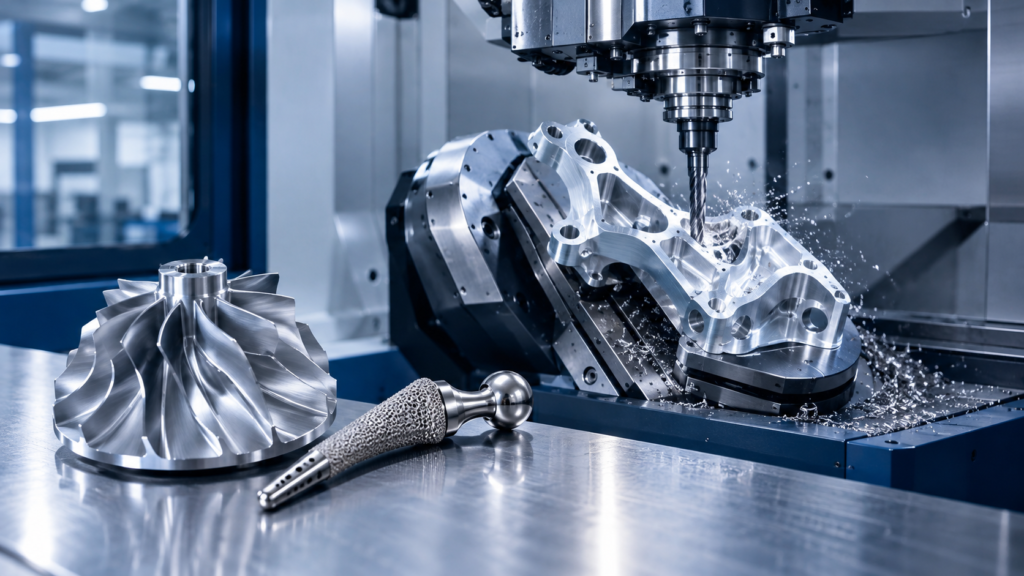
5-axis CNC machining cuts parts on five axes at once — the three linear axes (X, Y, Z) plus two rotary axes that tilt either the tool, the table, or both. The result: a complex multi-face part can be fully machined in a single setup instead of three to six. The hourly rate is higher than 3-axis work, but for impellers, turbine blades, mold cores, orthopedic implants, and multi-face structural brackets, 5-axis usually delivers lower total project cost and holds ±0.005 mm accuracy that multi-setup 3-axis work physically cannot match.
Send us your CAD for a free 5-axis DFM review — feedback within 12 hours →
If you’ve ever received a quote that looked too expensive on paper, waited weeks for fixtures, or watched a beautiful prototype drift out of spec on the second batch, this guide is for you. We’ll cover what 5-axis actually is, when it earns its keep, when it’s overkill, what tolerances you can realistically expect, and how to source it without getting burned.
Key Takeaways
- 5-axis = one setup, not six. Eliminate manual re-clamping, expensive custom fixtures, and the cumulative error that comes every time a part leaves the vise.
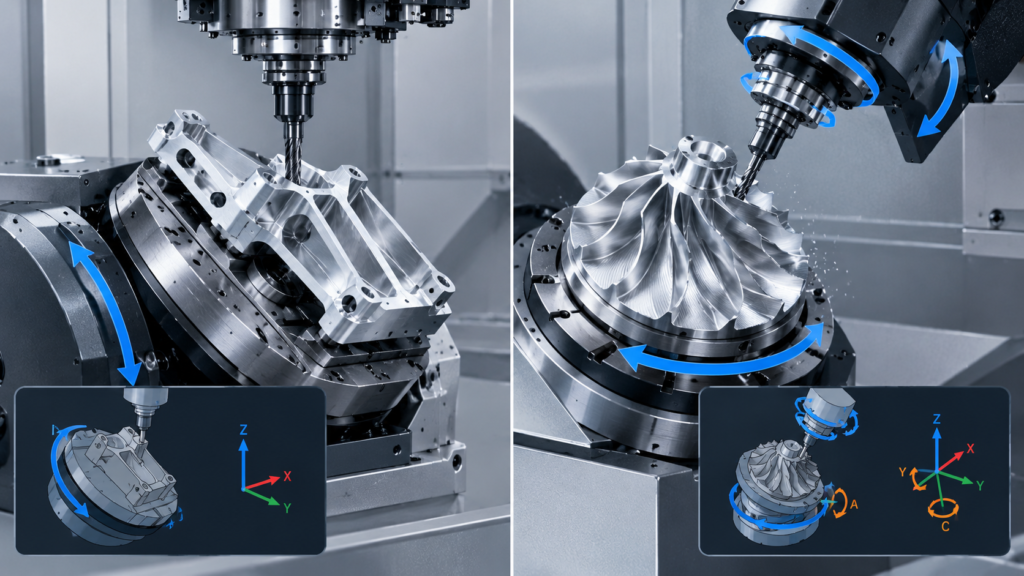
- There are two different machines people call “5-axis”: 3+2 positioning (cheaper, plenty for most parts) and true simultaneous 5-axis (required for impellers, blades, sculpted surfaces).
- Typical accuracy is ±0.005 mm on critical features, with the best shops reaching ±0.001 mm; surface finishes of Ra 0.4 µm are achievable directly off the machine.
- 5-axis is not always cheaper per hour, but it is usually cheaper per part on complex geometry — you pay back the premium through fewer fixtures, less labor, faster lead time, and lower scrap.
- Boraco runs 3-, 4-, and 5-axis mills under one 2,000 sqm Dongguan roof, with in-house finishing, CMM inspection, and a 12-hour DFM turnaround.
What Is 5-Axis CNC Machining?
On a conventional 3-axis mill, the tool moves in straight lines along X, Y, and Z. The spindle is always vertical relative to the table. To machine a side face, a hole at an angle, or an undercut, the operator stops, unclamps the part, re-fixtures it at an angle, and restarts. Every re-clamp introduces a small alignment error. On a part machined in four setups, those errors stack.
A 5-axis CNC machining center adds two rotary motions. Depending on the configuration, the worktable tilts and swivels (trunnion style) or the spindle head itself articulates (head style), so the tool can approach the part from almost any angle in a single hold. The workpiece never leaves its original zero-point coordinate — that’s the industry phrase “done-in-one” machining.
This matters for two reasons:
- Geometric freedom. The tool can reach undercuts, angled holes, and sculpted surfaces that a vertical spindle simply cannot touch without re-fixturing.
- Volumetric accuracy. Because the part is never moved, the relationship between every machined feature is determined by the machine, not by the operator’s hands.
You can read more about the underlying process on our CNC milling services page.
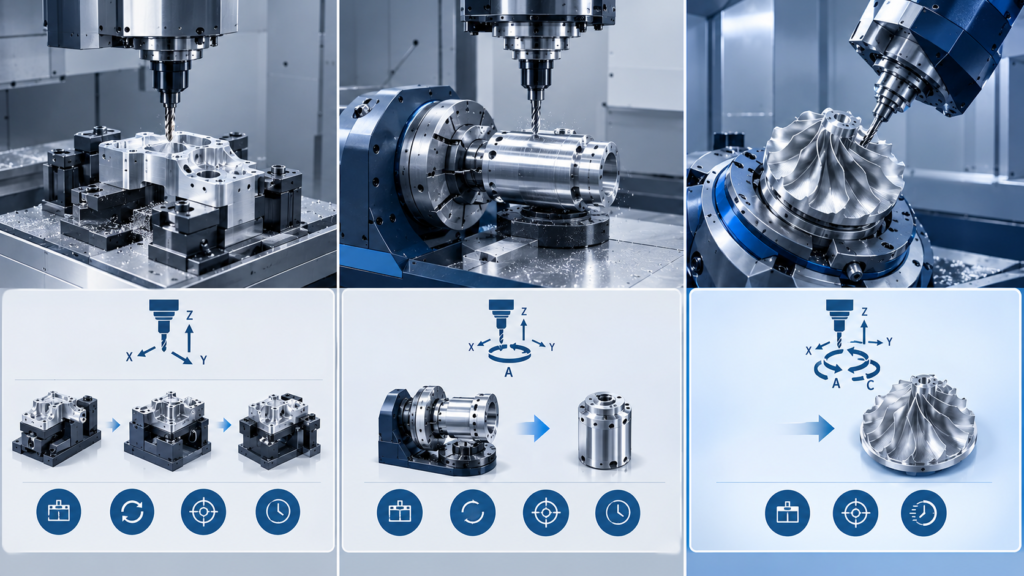
The Two Flavors: 3+2 (Positional) vs Simultaneous 5-Axis
This is the single most confused point in buyer emails evaluating 5-axis CNC machining. “5-axis” on a quote means one of two very different things, and the price difference is real.
| 3+2 (Positioning) 5-Axis | Simultaneous (True) 5-Axis | |
|---|---|---|
| What moves | Table tilts to an angle, locks, then cuts like a 3-axis machine | All five axes interpolate continuously during the cut |
| Best for | Multi-face parts, angled holes, complex pockets, mold blocks | Impellers, turbine blades, twisted vanes, sculpted/organic surfaces |
| CAM complexity | Standard 3-axis CAM with orientation | Needs a dedicated 5-axis CAM module, matched post-processor, and collision simulation |
| Hourly cost | Moderate premium over 3-axis | Significant premium |
| Collision risk | Low | High — bad toolpaths crash spindles |
3+2 covers roughly 70–80% of the parts buyers assume “need” true 5-axis. If your geometry has flat faces at angles, angled hole patterns, or pockets that need access from two sides, 3+2 is almost always enough — and costs 30–50% less. True simultaneous 5-axis is reserved for continuous-curvature surfaces where the tool must stay normal to the part the whole time.
When we receive a CAD file, our first engineering question is usually: “Can this run on 3+2, or do we really need simultaneous?” We’d rather save you money than burn machine hours.
5-Axis vs 3-Axis and 4-Axis: What Actually Changes
| Factor | 3-Axis | 4-Axis | 5-Axis |
|---|---|---|---|
| Axes | X, Y, Z | + 1 rotation | + 2 rotations |
| Setups for a complex part | 3–6 | 2–4 | 1 |
| Custom fixtures needed | Often several | Sometimes | Rarely |
| Typical tolerance | ±0.02–0.05 mm | ±0.01–0.03 mm | ±0.005–0.01 mm |
| Best for | Plates, brackets, simple housings | Cylindrical parts, cams, rotary features | Multi-face, undercuts, freeform surfaces |
| Lead time for prototype | Fast | Fast | Moderate (CAM time) |
| Cost on simple parts | Lowest | Low | Overkill |
| Cost on complex parts | High (fixtures + rework) | Medium | Usually lowest total |
Here’s a concrete example. A European medical-device client once sent us a titanium cranial implant blank that a previous shop had run through four setups on a 3-axis mill. The part came out dimensionally fine on each face — but the hole pattern drilled in the fourth setup was 0.12 mm off relative to the holes in the first setup, because the operator’s re-fixturing wasn’t perfect. The implant was rejected by the customer’s quality team. On our 5-axis trunnion, the same part ran in one hold. All holes referenced the same datum. The second article passed first-article inspection with no adjustments.
That 0.12 mm failure isn’t a machinist error — it’s physics. Every re-clamp has a few hundredths of a millimeter of repeatability uncertainty. On a tight tolerance part, that uncertainty is the whole game.
When 5-Axis Is Worth It (and When It Isn’t)
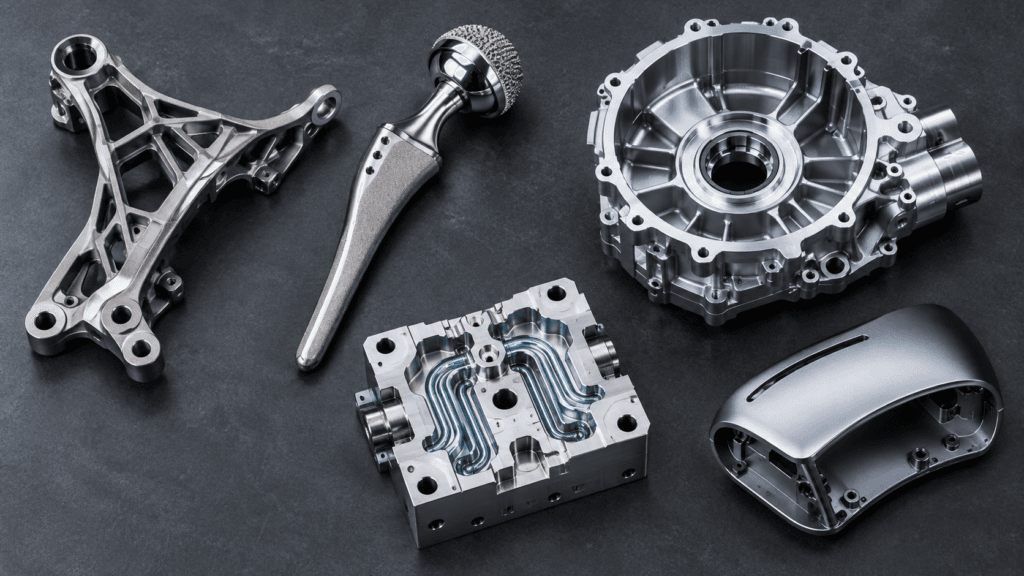
Be honest with yourself before you pay a 5-axis premium. Here is the practical test.
You probably need 5-axis when:
- The part has features on four or more faces that must align to one datum.
- You need undercuts, angled holes, or side access that a vertical spindle cannot reach.
- You’re machining turbine blades, impellers, or twisted vanes (simultaneous).
- The part has a sculpted or contoured surface that needs constant tool-to-surface contact.
- Tolerance between features is tighter than ±0.02 mm and the part already failed in multi-setup production.
- You’re prototyping geometry that would otherwise need casting tooling — titanium and aluminum blocks on a 5-axis mill replace castings for low-volume aerospace and medical work.
You probably don’t need 5-axis when:
- The part is a flat plate, a bracket, a spacer, or a 2.5D pocket.
- All features are accessible from the top.
- You’re running tens of thousands of identical parts where a dedicated fixture on a 3-axis line is cheaper per unit.
- Your “complex” part is just a round cylinder — a 4-axis lathe or mill-turn is enough.
- The design could be redesigned (DFM) so undercuts become draft angles.
A quick reality check: if your drawing only calls out one setup view, or the most complex feature is a pocket, ask your supplier to quote 3+2 first. Good engineers will push back and save you money — suppliers who quote true simultaneous 5-axis for a bracket are either lazy or pricing you for margin.
Industries That Live on 5-Axis
Aerospace. Structural brackets, turbine blades, impellers, and lightweight housings for aerospace CNC machining applications demand both tight tolerance and low weight. Titanium and Inconel parts run on 5-axis mills because fixturing them multiple times would destroy the accuracy budget.
Medical. Orthopedic implants (knee, hip, cranial), surgical guides, and instrumentation require complex curved surfaces and biocompatible materials like titanium Ti-6Al-4V and PEEK. We cover medical machining as a dedicated industry.
Automotive & motorsport. Motor housings, intake manifolds, suspension uprights, and EV battery components are increasingly 5-axis because castings are being replaced by machined billet for low and medium volumes.
Mold and die. Mold inserts, core pins, and conformal-cooling channels run on 5-axis to achieve complex cavity geometry in one setup.
Consumer products. Less obvious, but CNC machining for electronics uses 5-axis for curved speaker grilles, camera brackets, optics housings, and cosmetic enclosures where every face must blend without a visible seam.
Tolerances, Surface Finish, and What “Accurate” Really Means
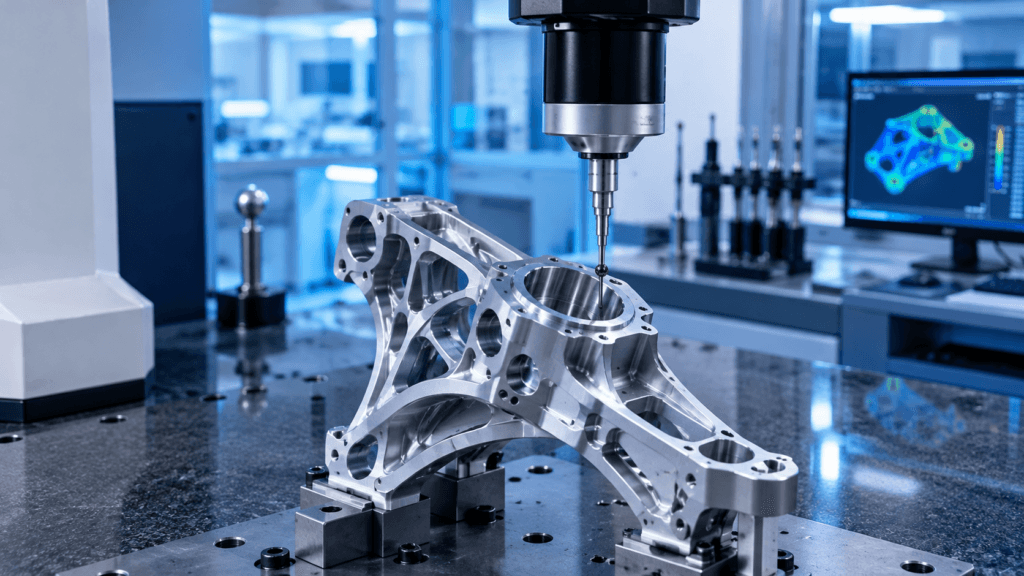
Buyers ask us this weekly: “What tolerance can 5-axis CNC machining hold?” The honest answer is:
- Standard shop tolerance: ±0.01–0.02 mm on critical dimensions, in line with ISO 2768-mK.
- Routine critical-feature work: ±0.005 mm (5 microns) on bearing bores, locating pin holes, and precision mating surfaces.
- Best-in-class, with CMM verification: ±0.001 mm (1 micron) on ultra-precision medical and aerospace features, run in a temperature-controlled room.
Surface finish directly off the machine is typically Ra 0.8–1.6 µm, and on simultaneous 5-axis sculpted surfaces we can hit Ra 0.4 µm without secondary polishing. For cosmetic consumer parts that need a perfect visual surface, we follow machining with finishing services — bead blast, anodize, polish, or powder coat — all in-house.
Two practical notes:
- Tolerance is meaningless without inspection reports. If a supplier promises ±0.005 mm but doesn’t include a CMM report with the batch, treat the promise as marketing.
- Geometric tolerancing matters more than linear tolerance. Position, profile, and concentricity between features are where multi-setup 3-axis parts actually fail.
Cost: Why the Hourly Rate Lies
This is the trap. A 5-axis CNC machining center costs more per hour — often 1.5× to 2.5× a 3-axis rate. But that comparison is wrong.
Total project cost = machine hours + fixture cost + setup labor + scrap + lead time.
| Cost factor | 3-Axis (multi-setup) | 5-Axis (single setup) |
|---|---|---|
| Machine hours | High (multiple ops) | Lower (done in one) |
| Custom fixtures | $500–$3,000 per fixture | Minimal or none |
| Setup labor | Multiple operators, multiple setups | One setup |
| Scrap risk | Higher (cumulative error) | Lower |
| Lead time | 2–4 weeks typical | 5–10 days typical |
| Inspection cost | Full re-check after each setup | One datum, one check |
A typical 20-piece aerospace bracket that needs $2,000 of fixtures and four setups on a 3-axis machine will often come out cheaper on 5-axis, despite the higher hourly rate. The 5-axis premium only loses when the part is genuinely simple.
For prototypes and bridge production, 5-axis also removes the casting-tooling question entirely: you can machine the production geometry from solid billet while you validate the design, then switch to die-casting or injection molding once the design freezes.
Sourcing 5-Axis Parts from China: What to Verify
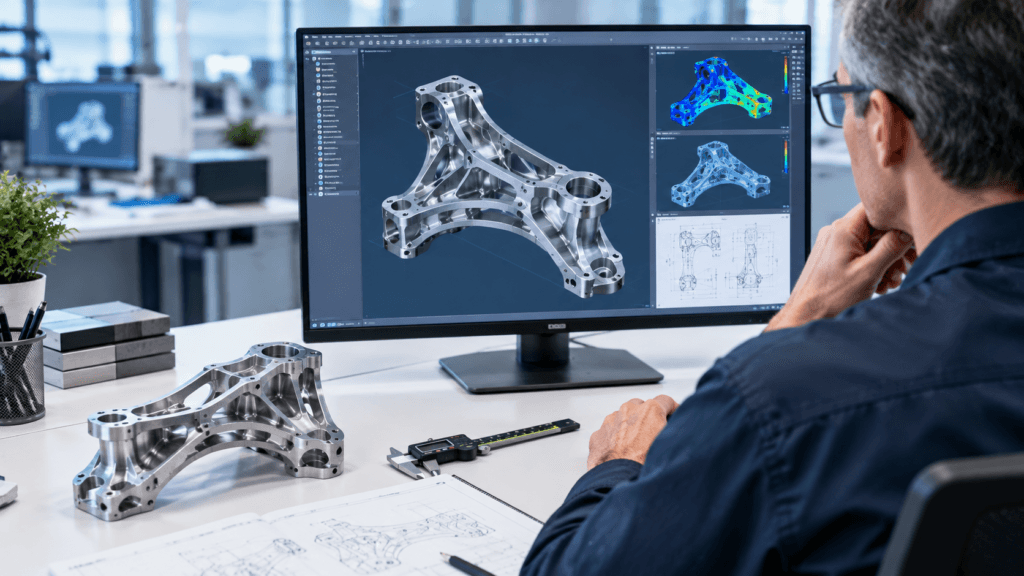
China has built an enormous 5-axis machining capacity in the last decade, but not every “5-axis” shop is equal. When you quote overseas, check four things:
- Machine brand and model. Real simultaneous 5-axis work runs on DMG MORI, Mazak, Hermle, Makino, or similar. A shop advertising 5-axis on generic Chinese vertical mills with a bolt-on rotary table is running 3+2 at best. Ask for the machine list.
- CAM and post-processor capability. True simultaneous 5-axis requires a trained programmer, a validated post, and simulation software that prevents spindle crashes. If the shop can’t describe its CAM stack, walk away.
- CMM and inspection room. Five-axis parts are only as good as their measurement. Ask for a sample inspection report on a past part.
- DFM response time. A serious 5-axis shop will flag that your undercut needs redesign, that your tolerance is over-specified, or that 3+2 is enough — before you pay.
A components buyer in Germany once told us about a “5-axis” supplier that quoted his impeller at half our price. Two months later, he learned the shop was running the geometry on a 3-axis mill with a homemade rotary fixture. The impeller vanes were not concentric, and the batch was rejected at his customer’s torque test. He came back to us; we ran the same part on a true 5-axis trunnion in nine days. The lesson: on 5-axis, the cheapest quote is usually the most expensive one.
At Boraco, we list our equipment, publish our inspection process, and respond to DFM questions within 12 hours. No MOQ, prototype to mass production under one roof.
Common Mistakes Buyers Make
- Specifying simultaneous 5-axis when 3+2 would do. You overpay 30–50% and add lead time for no geometric benefit.
- No DFM conversation before quoting. Without a design review, you’re paying for features the geometry doesn’t need.
- Ignoring CAM risk. A bad toolpath doesn’t just ruin a part — it can crash a $200k spindle. Make sure your supplier programs in simulation.
- Judging shops on machine count, not process. Five new DMGs in a row mean nothing if there’s no inspection room or engineering team.
- Buying only on price. As the impeller story above shows, the cheapest 5-axis quote is almost always a 3-axis job with a rotary table attached.
Frequently Asked Questions
Is 5-axis CNC machining more expensive than 3-axis?
The hourly machine rate is higher (typically 1.5–2.5×), but the total part cost on complex geometry is usually lower. You save on custom fixtures, repeated setups, labor, and scrap. For simple parts, 3-axis remains cheaper.
What tolerances can 5-axis machining hold?
Standard critical-feature tolerance is ±0.005 mm, with best-in-class shops reaching ±0.001 mm on ultra-precision aerospace and medical work. General dimensions follow ISO 2768-mK.
Do I need simultaneous 5-axis, or is 3+2 enough?
3+2 (positional) handles multi-face parts, angled holes, and pockets. True simultaneous 5-axis is only required for continuous-curvature surfaces like impellers, turbine blades, and sculpted organic forms. Our engineers will tell you which one your drawing actually needs.
How long is lead time for 5-axis prototypes?
Typical prototype lead time is 5–10 working days after DFM approval, depending on material and complexity. Production batches scale from 1 piece to tens of thousands.
Can you machine titanium and aluminum 5-axis parts?
Yes. We routinely machine 6061/7075 aluminum, stainless steel, titanium Ti-6Al-4V, brass, copper, PEEK, and engineering plastics on our 5-axis mills. See our full CNC machining materials list.
About Boraco
Boraco has been precision machining in Dongguan since 2013. Our 2,000 sqm integrated facility runs 3-, 4-, and 5-axis milling, turning, sheet metal, die casting, and finishing under one roof, exporting to North America, Europe, and Southeast Asia. We hold ISO 9001:2015, CE, and RoHS compliance, deliver 12-hour DFM feedback, and run without a minimum order quantity — so your first prototype and your 50,000th unit come off the same machines with the same process.
Send your CAD for a free DFM quote — response within 12 hours →
Browse our CNC machining service page or visit our CNC machining factory to learn how we run the process.