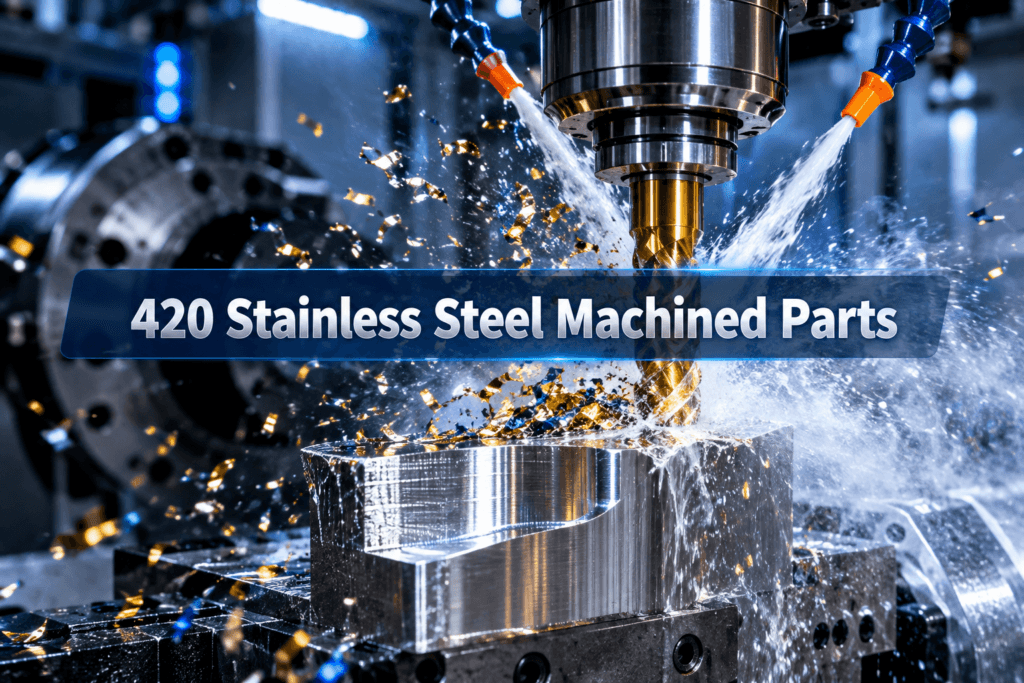
 420 Stainless Steel Machined Parts: Properties, CNC Machining Parameters, Heat Treatment, and Applications
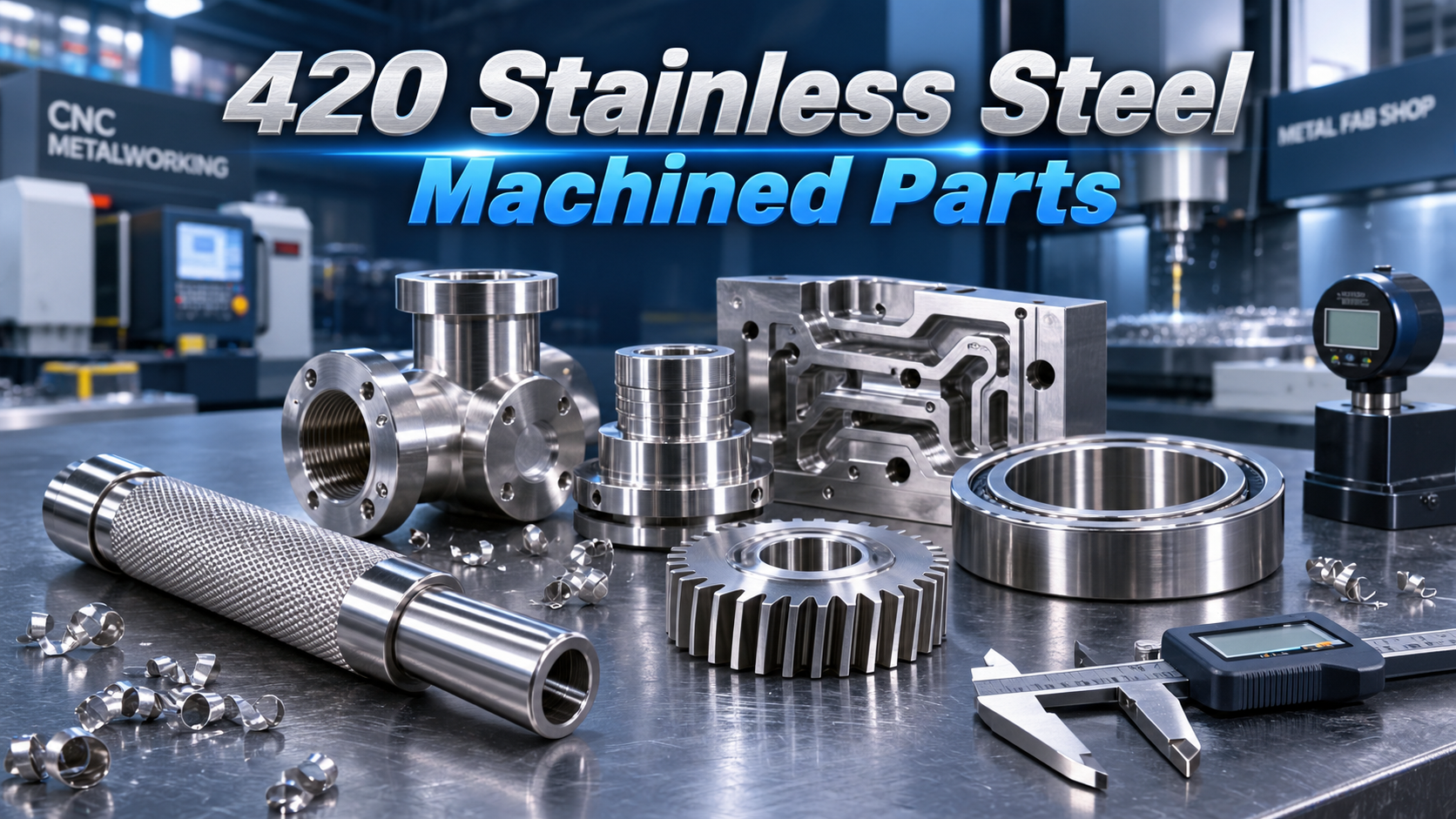
When a component must combine high hardness, wear resistance, dimensional accuracy, and moderate corrosion resistance, 420 stainless steel is a material worth evaluating. This hardenable martensitic stainless steel is widely considered for precision shafts, valve components, wear-resistant pins, tooling inserts, mechanical components, and other custom metal parts that require controlled mechanical properties.
However, successful production of 420 stainless steel machined parts involves more than selecting a stainless steel grade and programming a CNC machine. Material condition, cutting-tool geometry, chip evacuation, heat treatment, residual stress, and final inspection all influence part quality and manufacturing cost.
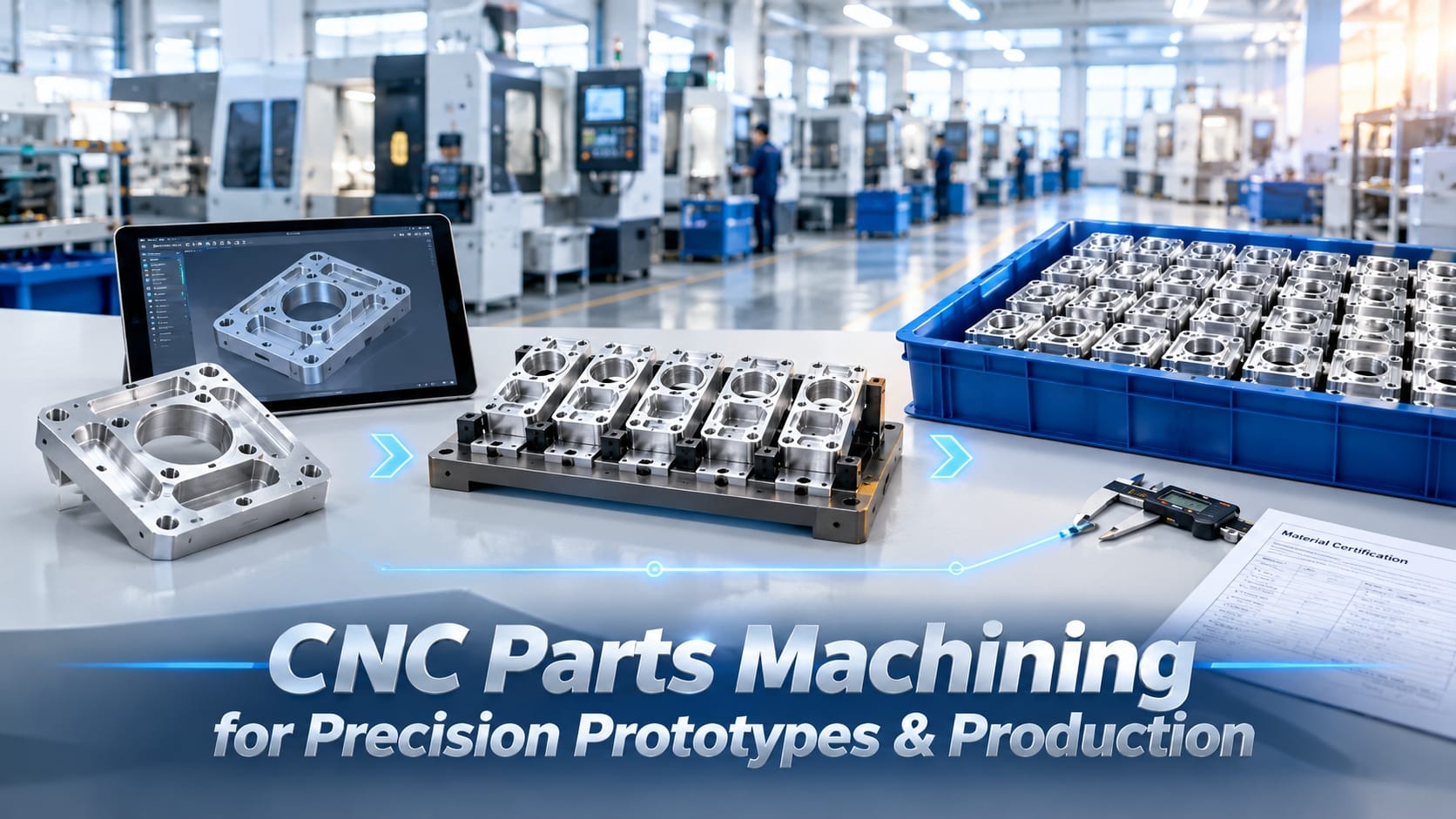
At Boraco Machining, established in 2013 in Dongguan, Guangdong, China, we provide custom CNC manufacturing solutions from a 2,000-square-meter production facility. Our capabilities include CNC milling, CNC turning, precision machining, prototyping, low-volume production, mass production, and finishing services. We support B2B buyers, OEM manufacturers, and engineering teams seeking reliable manufacturing partners for custom metal components.
This guide explains the engineering properties of 420 stainless steel, practical CNC machining considerations, heat-treatment options, finishing requirements, and purchasing specifications that help manufacturers achieve consistent results.
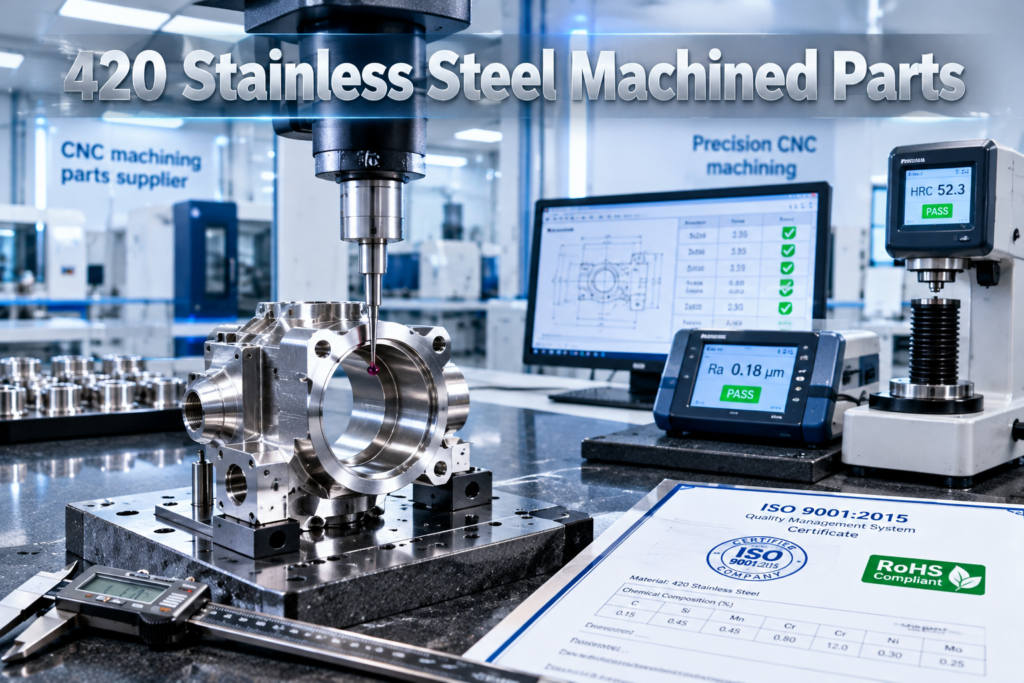
1. What Is 420 Stainless Steel?
420 stainless steel is a heat-treatable martensitic stainless steel containing approximately 12%–14% chromium under common grade specifications, together with a higher carbon content than many general-purpose stainless steels. Its composition enables hardening through controlled heating and quenching, followed by tempering to achieve the required balance of hardness, strength, and toughness.
Unlike austenitic stainless steels such as 304 and 316, 420 stainless steel can achieve substantially higher hardness after suitable heat treatment. This makes it attractive for applications involving sliding contact, edge retention, repeated mechanical loading, and moderate wear. However, its corrosion resistance is generally lower than that of 316 stainless steel, particularly in aggressive chloride environments.
For manufacturers evaluating cnc metal materials, 420 stainless steel is most appropriate when mechanical performance and wear resistance are more important than maximum corrosion resistance or easy machining.
Typical Material Characteristics
| Property | Typical Reference | Manufacturing Significance |
|---|---|---|
| Material family | Martensitic stainless steel | Heat-treatable and magnetic |
| Chromium content | Approximately 12%–14% | Provides corrosion resistance |
| Density | Approximately 7.7–7.8 g/cm³ | Useful for weight and material-cost calculations |
| Annealed hardness | Commonly around 190–240 HB, depending on grade and specification | Generally more machinable than hardened material |
| Hardened hardness | Approximately 48–54 HRC for some heat-treated conditions | Supports wear-resistant applications |
| Machinability | Moderate; condition-dependent | Requires suitable tooling and chip control |
| Corrosion resistance | Moderate; condition and environment dependent | Surface finish and service conditions matter |
Note: These are general engineering references, not guaranteed values for every 420 product. Actual properties depend on the specific grade designation, product form, material certificate, and heat-treatment condition. Always verify the applicable specification before production.
For additional material-selection guidance, explore Boraco’s CNC Machining Materials Guide and compare other options, including aluminum machining, steel machining, brass and copper machining, titanium machining, and plastic machining.
2. Why Choose 420 Stainless Steel for Machined Parts?
2.1 High Hardness and Wear Resistance
The primary advantage of 420 stainless steel is its ability to develop high hardness through heat treatment. When the application requires a surface that resists wear and maintains its working geometry, a properly hardened 420 component can offer a useful combination of mechanical strength and durability.
Typical applications include shafts, pins, bushings, mechanical guides, valve components, tooling parts, and selected mold components. The required hardness should be specified according to the contact pressure, wear mechanism, impact loading, and expected service life.
2.2 Good Surface-Finishing Potential
420 stainless steel can be ground and polished to achieve functional or decorative surface finishes. For sliding components, precision-ground surfaces may improve dimensional consistency and contact performance. For visible components, polishing can produce a smoother appearance and help reduce surface irregularities.
However, a polished surface does not automatically guarantee corrosion resistance. Surface contamination, heat-treatment condition, chemical exposure, and maintenance practices must also be considered.
2.3 A Practical Balance of Mechanical Performance and Cost
Compared with some higher-alloy stainless steels, 420 can be a cost-effective choice when its mechanical properties satisfy the application requirements. Total production cost depends on more than the raw material price: machining time, tool consumption, heat treatment, grinding, inspection, scrap risk, and production volume all contribute to the final part cost.
For procurement teams purchasing custom metal components, the correct material is the one that meets the functional specification without unnecessary processing or material expense.
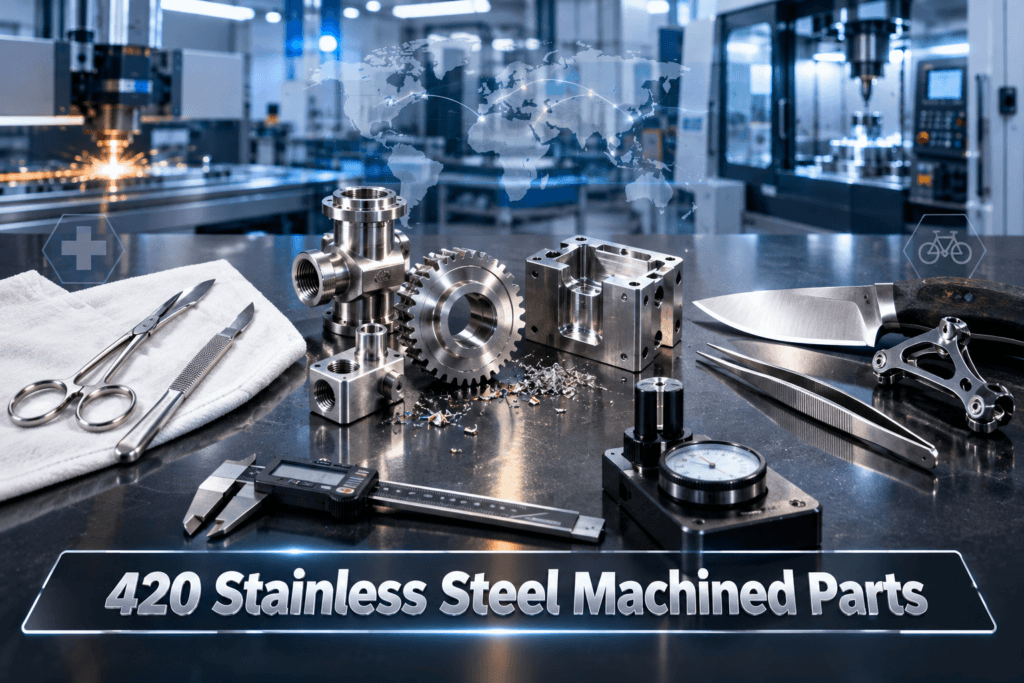
3. CNC Machining Processes for 420 Stainless Steel Parts
Choosing the appropriate machining process depends on part geometry, dimensional tolerances, batch size, surface requirements, and material hardness. Boraco Machining combines different manufacturing processes to support custom parts from prototypes to repeat production.
3.1 CNC Milling
CNC milling services are suitable for producing flat surfaces, pockets, slots, mounting features, complex contours, and multi-face components. Depending on the design, milling operations may include face milling, shoulder milling, slotting, drilling, and precision contouring.
For 420 stainless steel, stable workholding and controlled engagement are essential. Excessive tool engagement can increase cutting forces, vibration, heat generation, and insert wear. Sharp carbide tools, suitable chip-breaker geometry, and consistent coolant delivery help maintain process stability.
For components with features on multiple faces, custom CNC machining services can integrate milling and drilling operations into a coordinated production plan, reducing unnecessary setups and potential datum errors.
3.2 CNC Turning
CNC turning services are appropriate for cylindrical components such as shafts, pins, bushings, valve elements, threaded fittings, and precision sleeves.
During turning, long or stringy chips may develop depending on the material condition, feed rate, tool geometry, and cutting parameters. Chip control is especially important in automated production because uncontrolled chips can damage finished surfaces, interfere with tool movement, or interrupt machining cycles.
For high-volume orders, a repeatable turning process should include verified tool offsets, consistent stock dimensions, suitable chip evacuation, and a defined inspection frequency.
3.3 Precision Machining and Multi-Axis Operations
Some 420 stainless steel components require several intersecting features, complex profiles, or accurate relationships between multiple surfaces. In these cases, a coordinated precision-machining strategy can reduce repositioning errors and improve consistency.
Critical dimensions should be identified before programming. Datum references, hole-position tolerances, concentricity, perpendicularity, and geometric dimensioning and tolerancing (GD&T) requirements should be clearly defined on the engineering drawing.
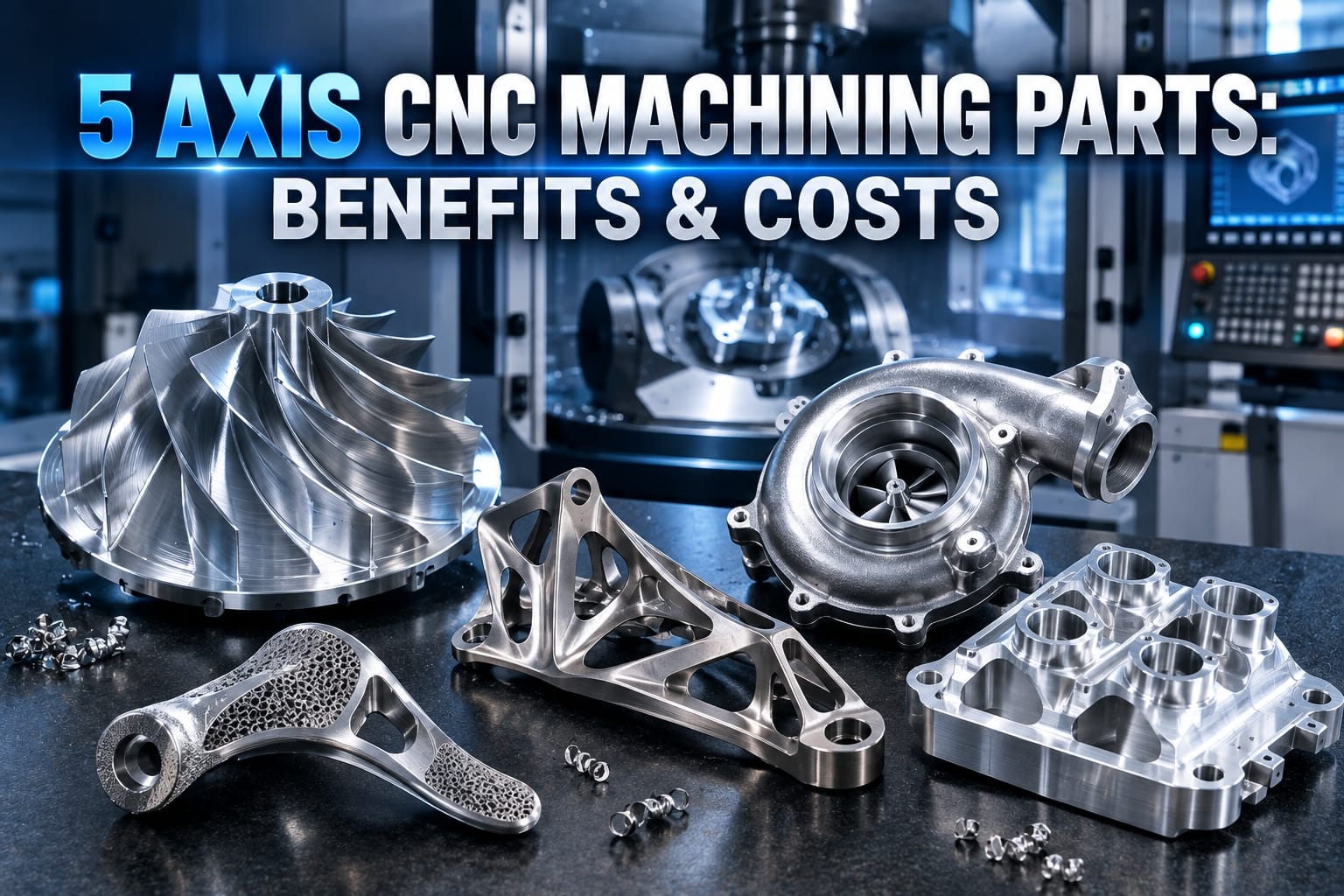
When a design requires more complex geometry, the engineering team should evaluate whether a multi-axis machining strategy offers measurable advantages over conventional setups. The objective is to achieve the specified geometry with a stable and economically viable process.
3.4 Laser Cutting and Supporting Fabrication Processes
Laser cutting is generally associated with sheet-metal blanks and profiles rather than the main machining route for solid 420 stainless steel components. Depending on the product design and material form, metal laser cutting may support blank preparation before subsequent machining or fabrication.
Laser-cut edges can contain a heat-affected zone, dross, or local surface changes. Where these areas become precision interfaces, sealing surfaces, or fatigue-sensitive features, additional machining or finishing may be required.
For broader manufacturing projects, Boraco also provides sheet metal processing, mold-making services, and coordinated finishing operations. The selected process should match the material form, design requirements, and production economics.
4. Practical CNC Machining Parameters for 420 Stainless Steel
Machining parameters should be established according to the actual grade, hardness, cutting-tool manufacturer recommendations, machine rigidity, coolant system, and workpiece geometry. Annealed 420 and hardened 420 should not be treated as equivalent machining conditions.
The following ranges are initial reference values for engineering trials, not universal production settings. Confirm them with the tool supplier and validate them through controlled test cuts before releasing a production program.
| Operation | Initial Cutting-Speed Reference | Important Considerations |
|---|---|---|
| Carbide milling | Approximately 80–120 m/min | Use stable engagement, suitable chip thinning compensation, and effective chip evacuation. |
| Carbide turning | Approximately 100–180 m/min | Adjust for hardness, insert grade, workpiece diameter, and continuous or interrupted cutting. |
| Carbide drilling | Approximately 50–90 m/min | Consider drill geometry, hole depth, coolant delivery, and chip removal. |
| Finishing operations | Determine by tool and application | Prioritize dimensional stability, surface finish, and predictable tool wear. |
Important: The ranges above are conservative starting estimates for process development and are not certified settings for every 420 stainless steel condition. Published machining references may recommend higher speeds for specific carbide grades and stable setups. Hardened parts may require substantially lower cutting speeds, specialized tooling, or grinding instead of conventional milling.
4.1 Cutting Speed and Spindle Speed
Cutting speed is the relative speed between the cutting edge and the workpiece surface. For a rotating tool or workpiece, spindle speed can be estimated using the following formula:
n = (1000 × Vc) / (π × D)
- n: Spindle speed in revolutions per minute (rpm).
- Vc: Cutting speed in meters per minute (m/min).
- D: Tool diameter for milling or workpiece diameter for turning, in millimeters.
For example, a 10 mm carbide end mill running at a cutting speed of 100 m/min requires approximately 3,183 rpm. This is a mathematical starting point; the final spindle speed must remain within the machine, tool, and workholding limits.
4.2 Feed Rate and Chip Control
For milling, feed rate can be calculated using:
Vf = fz × z × n
- Vf: Feed rate in millimeters per minute.
- fz: Feed per tooth in millimeters.
- z: Number of effective cutting teeth.
- n: Spindle speed in rpm.
Feed per tooth must be selected according to the cutter diameter, flute count, radial engagement, axial depth of cut, and material condition. A feed that is too low can cause rubbing and heat accumulation, while an excessive feed may overload the cutting edge or compromise surface quality.
For turning, feed per revolution is another important variable. The correct value depends on the desired surface finish, insert nose radius, cutting forces, and rigidity of the setup. A documented trial-cut process is more reliable than copying a single parameter from an unrelated application.
4.3 Coolant, Tooling, and Workholding
Effective coolant delivery helps remove heat and evacuate chips from the cutting zone. A suitable carbide grade and coating can improve tool life, but tool selection must also account for the workpiece hardness and the possibility of interrupted cuts.
For precision cnc metalworking, rigid workholding, minimum practical tool overhang, stable machine conditions, and controlled tool wear are essential. When machining thin sections or parts with asymmetric material removal, consider intermediate inspection or stress-relief requirements to manage dimensional changes.
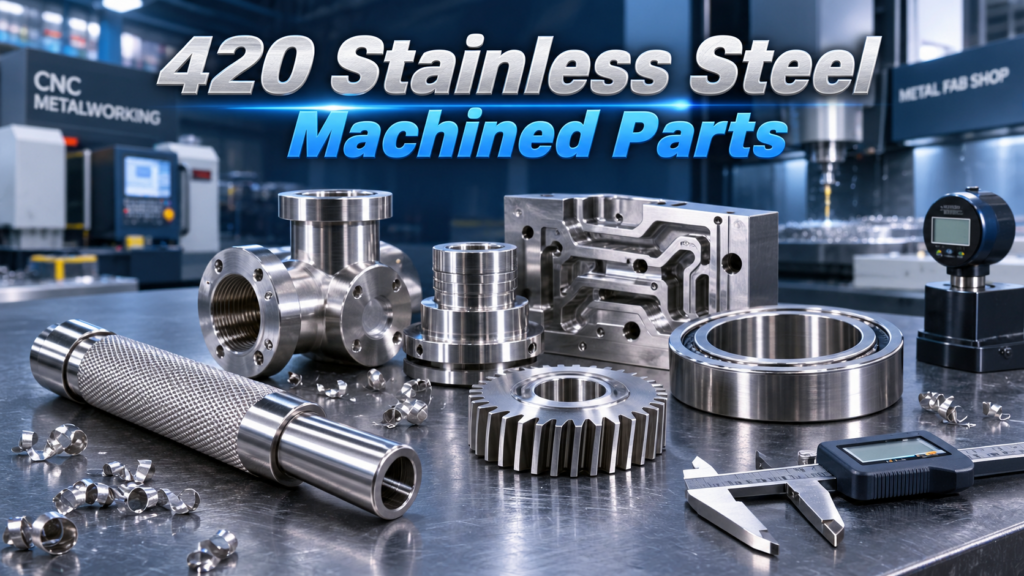 5. Heat Treatment: When and How Should 420 Stainless Steel Be Hardened?
Heat treatment is often the defining step in the production of 420 stainless steel machined parts. It changes the material’s hardness and strength, but it can also introduce distortion and residual stress. The manufacturing sequence should therefore be established before the first production run.
Two common approaches are machining in the annealed condition followed by hardening, or machining material supplied in a specified pre-hardened condition. The appropriate route depends on feature complexity, required hardness, final tolerances, and finishing allowance.
5.1 Common Heat-Treatment Stages
| Stage | Typical Reference | Purpose |
|---|---|---|
| Annealing | Approximately 840–900°C | Improves machinability and prepares the material for subsequent processing. |
| Austenitizing | Approximately 980–1,065°C | Prepares the structure for hardening. |
| Quenching | Controlled cooling according to section size and grade | Develops the hardened martensitic structure. |
| Tempering | Selected according to the target hardness and toughness | Adjusts the balance of hardness, strength, and toughness after hardening. |
These are broad reference ranges only. The exact cycle must follow the material supplier’s data, the applicable grade specification, section thickness, furnace capability, and required final properties. Quenching media and tempering temperature must not be selected from a generic table without engineering review.
5.2 Machining Before or After Hardening?
For many complex parts, machining in the annealed condition is more economical because cutting forces and tool wear are generally easier to manage. The component can then undergo heat treatment, followed by finish grinding or carefully selected finishing operations where necessary.
However, heat treatment may change dimensions. If a component contains precision bores, bearing fits, sealing faces, or tight positional tolerances, the process plan should allow suitable finishing stock and post-treatment inspection.
Machining hardened 420 may be appropriate for selected features, but conventional cutting becomes more demanding as hardness increases. For very hard surfaces or highly controlled cylindrical dimensions, precision grinding may offer a more suitable finishing route.
6. Surface Finishing for 420 Stainless Steel Machined Parts
Surface finishing should be selected according to the component’s functional requirements, not solely its appearance. Boraco’s finishing services can be considered as part of a coordinated manufacturing plan, subject to process compatibility and project requirements.
6.1 Precision Grinding
Grinding is commonly used when hardened 420 stainless steel parts require tight dimensional control, improved roundness, or a consistent surface finish. It is particularly relevant to shafts, pins, sliding components, and precision interfaces.
6.2 Polishing
Mechanical polishing can reduce surface irregularities and improve appearance. For components exposed to moisture or cleaning agents, the required surface condition should be defined together with the service environment. Polishing alone does not eliminate every corrosion risk.
6.3 Passivation and Corrosion Management
Passivation may be appropriate when permitted by the grade, heat-treatment condition, and application requirements. The treatment should be specified and validated rather than assumed to be necessary or suitable for every part.
For critical applications, define acceptable surface contamination, finishing chemicals, post-treatment cleaning, and inspection criteria. Where corrosion resistance is essential, verify performance under representative service conditions.
6.4 Surface Roughness Requirements
Surface roughness should be specified according to function. A non-contact external surface may not require the same finish as a sealing face, sliding interface, or precision fit.
As an illustrative design reference, a machined surface may be specified at Ra 1.6–3.2 μm for general functional applications, while selected precision or sealing surfaces may require Ra 0.8 μm or lower. These are application-dependent examples, not guaranteed results for every geometry or process.
Always state the required roughness parameter, measurement location, evaluation method, and acceptance criteria on the drawing or inspection specification.
7. Quality Control for Custom Metal Parts
Quality assurance should cover the complete production process, from material verification to final dimensional inspection. A part that meets its nominal dimensions but uses the wrong material condition or misses the specified hardness requirement may still fail in service.
7.1 Material Verification
Confirm the material grade, applicable standard, product form, and delivery condition before machining. Where required by the purchase order, request material test certificates and establish traceability between the raw material lot and finished components.
7.2 Dimensional Inspection
Inspection methods should match the drawing requirements. Depending on the part, these may include calibrated micrometers, calipers, bore gauges, height gauges, coordinate measuring machines, and suitable thread gauges.
Critical dimensions should be identified in advance. For batch production, a documented inspection plan can establish first-article verification, in-process checks, sampling frequency, and final acceptance criteria.
7.3 Hardness and Surface Inspection
When heat treatment is specified, hardness testing should verify the required condition using an appropriate test method and location. Surface inspection should also identify burrs, tool marks, scratches, grinding burns, and other defects relevant to function.
Boraco Machining operates under a quality-focused manufacturing approach and lists ISO 9001:2015, CE, and RoHS among its company credentials. Buyers should verify the applicability and current validity of relevant certificates and determine which standards or declarations apply to the specific product being purchased.
8. Applications Across Industrial Sectors
420 stainless steel can be considered for applications where hardness, wear resistance, and moderate corrosion resistance are required together. Final suitability depends on the design, operating environment, and applicable industry requirements.
- Automotive and motorcycles: Selected pins, shafts, mechanical interfaces, and wear-resistant components. Explore automotive machining.
- Industrial and mechanical equipment: Precision guides, valve components, bushings, and selected tooling elements.
- Aerospace and aviation: Potentially suitable for selected non-critical or application-qualified components, subject to material, traceability, and aerospace qualification requirements. Learn about aerospace CNC machining.
- Electronics: Selected mechanical parts, fixtures, and precision hardware where the required mechanical properties justify stainless steel. See CNC machining for electronics.
- Medical equipment: Certain mechanical components and instruments may use 420, provided the exact grade, cleanliness, corrosion performance, biocompatibility, and regulatory requirements are satisfied. Review medical machining capabilities.
For an overview of the sectors served by Boraco, visit the industries served page.
9. How to Reduce the Cost of 420 Stainless Steel CNC Machining
For B2B procurement teams, cost optimization should consider the full manufacturing route rather than the hourly machine rate alone. A well-designed part can reduce cutting time, inspection complexity, finishing operations, and the risk of rework.
9.1 Optimize the Part Design
Avoid unnecessarily deep pockets, extremely thin walls, and inaccessible internal features when these are not functionally required. Use practical corner radii compatible with available tooling, and specify tight tolerances only on dimensions that directly affect fit, performance, or assembly.
9.2 Select the Correct Material Condition
Discuss the target hardness and heat-treatment route before production. Machining annealed material and hardening it afterward may be more efficient for complex geometry, while pre-hardened stock may be suitable for certain tooling or simpler components. The choice should be evaluated against distortion risk and finishing requirements.
9.3 Plan Production Quantities
Prototype quantities, low-volume orders, and repeat production runs have different cost structures. Initial setup and programming costs are spread across more parts as order quantities increase, while high-volume work may benefit from dedicated fixtures and optimized tool paths.
For sourcing teams comparing a metal fab shop or a specialized CNC manufacturer, it is important to compare equivalent specifications, including material grade, hardness, tolerances, surface finish, inspection requirements, and packaging.
Likewise, the term heavy metal cnc does not identify a specific machining process or material grade. Buyers should communicate the actual alloy, part dimensions, machining features, and performance requirements to obtain technically meaningful quotations.
10. What Should Buyers Include in an RFQ?
A complete request for quotation helps the manufacturing team assess feasibility, recommend an appropriate process, and calculate a more reliable production cost.
- Material: AISI 420 / UNS S42000 or the exact required standard and grade.
- Material condition: Annealed, pre-hardened, or heat-treated, with the required hardness where applicable.
- Engineering files: A dimensioned 2D drawing and a 3D CAD file where available.
- Tolerances: Critical dimensions, geometric tolerances, datum references, and thread specifications.
- Surface requirements: Roughness values, polishing or grinding requirements, and corrosion-related specifications.
- Quantity: Prototype quantity, initial order quantity, and estimated annual demand if available.
- Inspection: Material certificates, hardness reports, dimensional reports, first-article inspection, or other required documentation.
- Delivery and packaging: Required delivery date, shipment destination, labeling, and protection against transit damage.
Providing these details early helps engineers identify potential manufacturing risks before production begins. It also makes supplier quotations easier to compare on a like-for-like basis.
11. Why Work with Boraco Machining?
Boraco Machining was established in 2013 and operates from a 2,000-square-meter manufacturing facility in Dongguan, China. We support overseas OEMs, engineering teams, and purchasing departments seeking custom precision components and coordinated manufacturing services.
Our production capabilities include CNC milling, CNC turning, precision machining, 4-axis and 5-axis CNC machining, laser and wire cutting, punching, forming and bending, welding and assembly, die casting, rapid prototyping, low-volume production, mass production, and finishing services.
For customers developing custom metal components, our manufacturing approach focuses on engineering review, process suitability, dimensional requirements, and consistent production planning. We also support projects involving aluminum, steel, copper alloys, titanium, and engineering plastics when an alternative material is more appropriate for the application.
To learn more about our background, capabilities, and manufacturing approach, visit the About Boraco Machining page. You can also browse our CNC machining technical articles for additional manufacturing insights.
12. Frequently Asked Questions About 420 Stainless Steel Machined Parts
Is 420 stainless steel suitable for CNC machining?
Yes. 420 stainless steel can be machined using CNC milling, turning, drilling, and other appropriate processes. Machining is generally more manageable in the annealed condition. Hardened material may require specialized tooling, lower cutting speeds, or grinding for critical features.
Can 420 stainless steel be hardened after machining?
Yes. A common manufacturing route is to machine the component in the annealed condition, harden it through a controlled heat-treatment process, temper it to the required properties, and then finish critical surfaces as needed. The sequence must account for potential dimensional distortion.
Is 420 stainless steel more corrosion-resistant than 304 or 316?
Not generally. Although 420 contains chromium and offers useful corrosion resistance under suitable conditions, 304 and especially 316 are often better choices for applications requiring broad corrosion resistance. Selection should reflect the actual chemicals, moisture, temperature, cleaning procedures, and maintenance conditions.
What tolerances can be achieved for 420 stainless steel parts?
Achievable tolerances depend on part geometry, dimensions, material condition, machine capability, workholding, and whether post-heat-treatment grinding is necessary. A tolerance such as ±0.01 mm may be feasible for selected features under controlled conditions, but it should never be assumed for every part without drawing review and process validation.
What information is needed to quote custom 420 stainless steel components?
Provide the engineering drawing, material specification, target hardness, critical tolerances, surface finish, order quantity, inspection requirements, and delivery schedule. A 3D CAD model is also helpful for evaluating complex geometry and planning the machining route.
Conclusion: Source 420 Stainless Steel Machined Parts with Confidence
420 stainless steel is a useful engineering material when a component needs heat-treatable hardness, wear resistance, and moderate corrosion resistance. Achieving consistent results requires a coordinated approach to material verification, CNC machining, heat treatment, surface finishing, and dimensional inspection.
Whether you need prototype components, a low-volume production run, or repeat orders of precision metal parts, the manufacturing plan should begin with a clear understanding of the operating environment and engineering requirements.
Planning a 420 stainless steel machining project? Send your drawings, material requirements, target hardness, and order quantity to Boraco Machining. Our team can review the manufacturing requirements and discuss a suitable production approach for your project.
Contact Boraco Machining for a Quote
Technical References
- World Stainless — Stainless Steel Grade Sheets. Reference information on grade 420 composition and specified properties.
- Carpenter Technology — CarTech 420 Stainless Steel Data Sheet. Reference information on heat treatment, hardness, and machinability.
- Penn Stainless — 420 Stainless Steel. Reference information on processing, annealing, hardening, and machining considerations.
- Machining Doctor — Stainless Steel 420 Machining Data. Reference information on cutting speeds, tool selection, and machining guidelines.
Technical disclaimer: Material properties and machining recommendations vary with grade, product form, heat treatment, tooling, and operating conditions. The referenced information is provided for engineering guidance and should be verified against current supplier documentation and project-specific requirements before production.
“`