Quick Answer
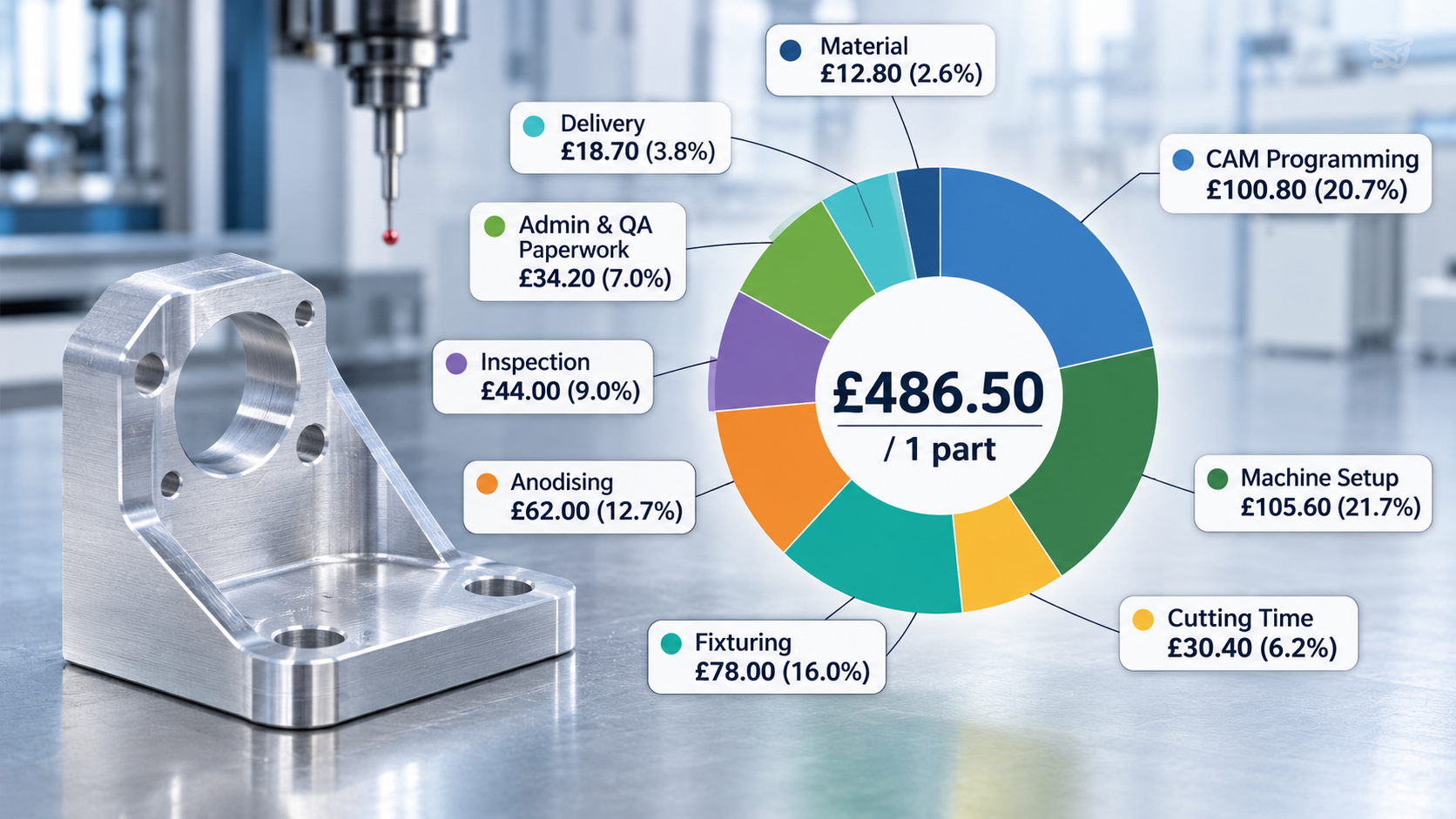
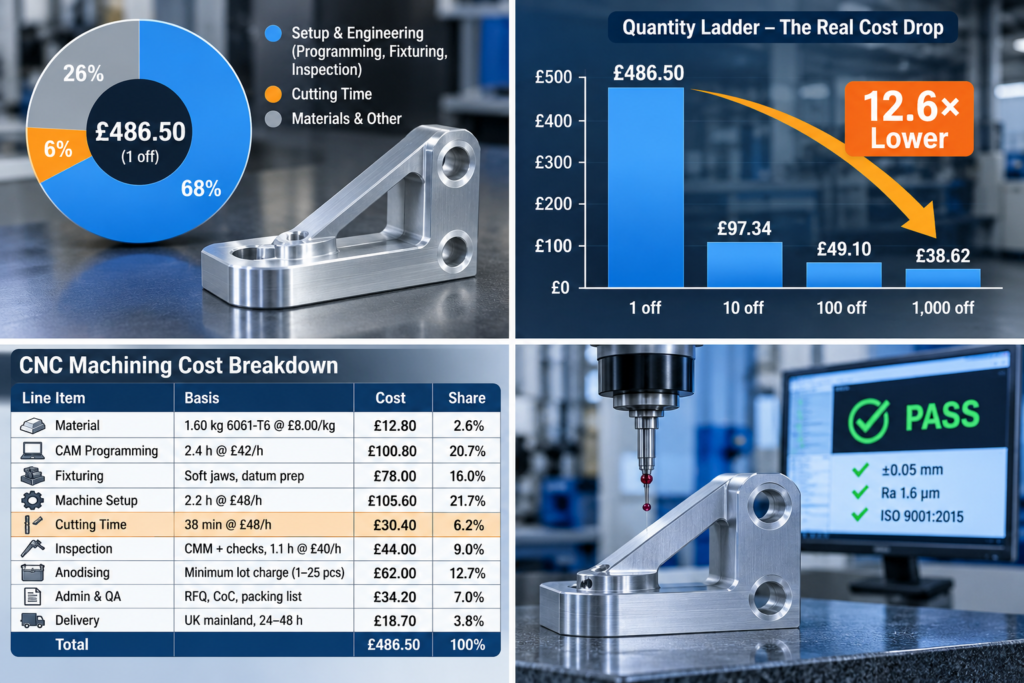
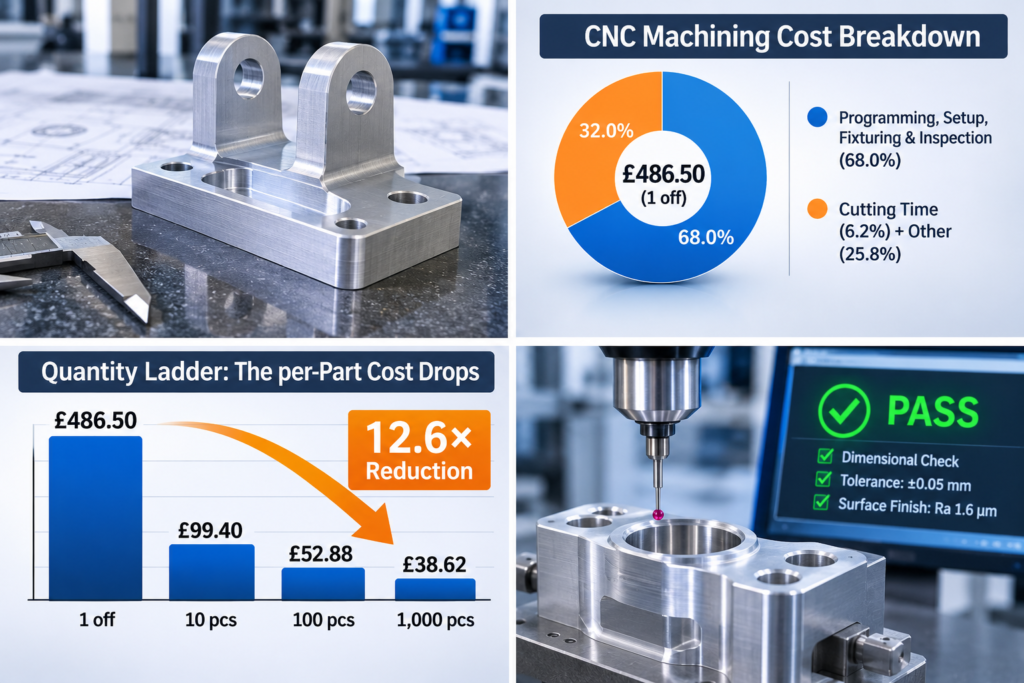
- On a one-off CNC order, cutting time is 6% of the price. Programming, setup, fixturing and inspection account for 68%.
- A 6061-T6 bracket quoted at £486.50 for one falls to £38.62 at 1,000 off — a 12.6× reduction, almost entirely from amortisation, not from faster machining.
- The three line items that surprise buyers most are CAM programming, metrology and supplier minimum lot charges.
- If a quote looks high, ask for the setup and inspection hours — not a discount. The hours are where the number lives.
Why we publish our own quotes
Most machining quotes arrive as a single number: 25 off, £19.46 each. It is accurate and completely unhelpful. You cannot tell whether you are paying for a hard part, a slow shop, or a supplier who priced the risk of getting it wrong.
At Boraco we quote around 340 RFQs a month. Roughly one in five comes back with the same question: why is this more than the last supplier? Nine times out of ten the answer is not the hourly rate — it is how much of the order is one-off work that only gets paid for once.
So we are publishing our teardowns. Real parts, real line items, real hours, with the arithmetic shown. Part numbers and customer details are changed; the numbers are not.
The part: BR-2041
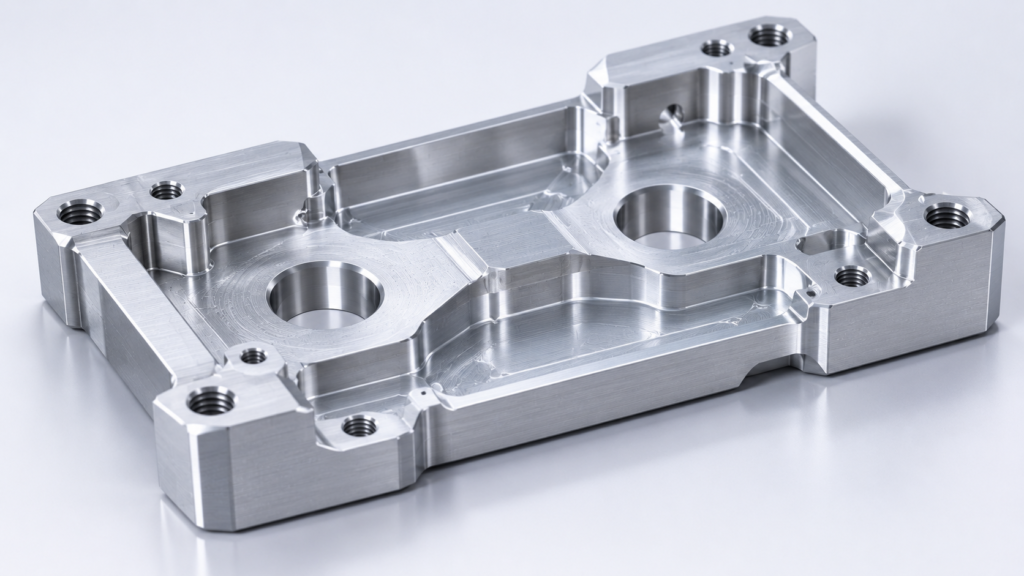
A representative job from our 3-axis cell — the kind of component that makes up most enquiries we receive.
| Attribute | Specification |
|---|---|
| Material | 6061-T6 aluminium plate |
| Envelope | 180 × 95 × 42 mm |
| Blank mass | 1.60 kg |
| Finished mass | 0.41 kg (74% removed) |
| Critical features | 2 × Ø12 H7 bores, bore-to-bore centre distance ±0.05 mm |
| General tolerance | ISO 2768-m |
| Flatness | 0.05 mm over the mounting face |
| Surface finish | Ra 1.6 µm on the sealing face |
| Finish | Clear anodise, Type II, 12 µm |
| Quantity quoted | 1 off, then 10 / 100 / 1,000 for comparison |
Note the mass figure before anything else: we remove 1.19 kg of the 1.60 kg blank. 74% of the material you pay for leaves as swarf. Blank size discipline is a cost lever, and it is one of the first things we raise in a DFM review.
The teardown: one-off, quoted at £486.50
| Line item | Basis | Cost | Share |
|---|---|---|---|
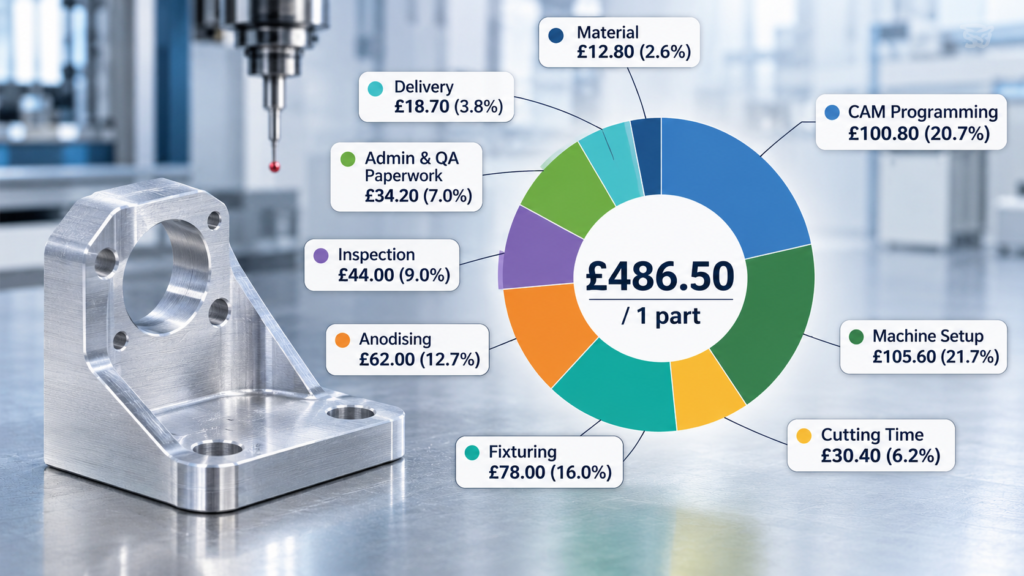
| Material | 1.60 kg 6061-T6 plate @ £8.00/kg | £12.80 | 2.6% |
| CAM programming | 2.4 h @ £42/h — 3-axis toolpaths, 2 setups, H7 bore strategy | £100.80 | 20.7% |
| Fixturing | Soft jaws machined, vise stops, datum prep | £78.00 | 16.0% |
| Machine setup | 2.2 h @ £48/h — tool load, probing, first-article offsets | £105.60 | 21.7% |
| Cutting time | 38 min @ £48/h | £30.40 | 6.2% |
| Inspection | CMM first article + in-process bore checks, 1.1 h @ £40/h | £44.00 | 9.0% |
| Anodising | Outsource, minimum lot charge (1–25 pcs) | £62.00 | 12.7% |
| Admin & QA paperwork | RFQ review, drawing query, CoC, packing list | £34.20 | 7.0% |
| Delivery | UK mainland, tracked, 24–48 h | £18.70 | 3.8% |
| Total | £486.50 | 100% |
The single most useful number on that table is the cutting time: £30.40, or 6.2% of the invoice. The metal is being cut for less than half an hour. Everything else — £456.10 — is work that happens once, regardless of quantity.
That is not a trick or an excuse. It is what a compliant, traceable, CMM-verified part actually costs to set up in a UK shop running ISO 9001:2015 with calibrated metrology and a documented first-article report.
Where the money actually hides
1. Programming is engineering, not typing
Those 2.4 hours are not spent clicking “generate”. Roughly half is deciding how to hold the part for the second operation without losing the 0.05 mm flatness, choosing the order of roughing passes so the bore does not distort when 74% of the blank comes off, and setting up the probing routine that catches a bad datum before it becomes a scrapped part. The toolpath is the last 40 minutes of it.
2. Metrology costs more than people expect
£44 for inspection on a single part is close to 9% of the price. On a ±0.05 mm bore, that is a CMM programme, a first-article report and a signed certificate — none of which a shop can fake without risking the whole order. On ±0.10 mm general features it drops sharply, which is exactly why blanket tolerances are expensive.
3. Minimum lot charges are invisible until they are not
Anodising at £62 for one part is not a mark-up; it is a plating line’s minimum load. The same £62 is spread across 1,000 parts at £0.06 each. Buyers who compare “machining only” prices from two suppliers and then discover a £60 finishing charge on one of them are usually comparing a shop that bundles finishing with one that does not.
4. What we do not charge for
Worth stating plainly, because it appears in competitors’ quotes and not ours: no setup fee on repeat orders of the same revision, no drawing-query charge, no expedite fee inside our standard lead time, and no charge for a DFM review before quoting. If a feature can be removed to save you money, we say so before you place the order.
The same part at four quantities
Same drawing, same shop, same month. Only the order quantity changes.
| Quantity | Material | Order-level work (CAM, fixture, setup, admin, delivery) | Cutting | Inspection | Anodising | Order total | Unit price |
|---|---|---|---|---|---|---|---|
| 1 | £12.80 | £337.30 | £30.40 | £44.00 | £62.00 | £486.50 | £486.50 |
| 10 | £128.00 | £370.60 | £304.00 | £99.80 | £62.00 | £964.40 | £96.44 |
| 100 | £1,280.00 | £586.60 | £2,400.00 | £240.00 | £390.00 | £4,896.60 | £48.97 |
| 1,000 | £12,800.00 | £1,424.40 | £19,800.00 | £1,500.00 | £3,100.00 | £38,624.40 | £38.62 |
Two things to read from this. First, the curve is steepest between 1 and 100 — that is the amortisation window, and it is where most buyers leave money on the table. Second, at 1,000 off the price is dominated by cutting time and material (85% combined), which is why volume quotes respond to cycle-time and blank-size improvements rather than to negotiation.
The 100-off figures also include the honest reason volume is not free: cycle time drops only from 38 to 30 minutes, because the second setup and the bore checks do not disappear — we just get better at them.
Seven things that move the number
- Blank size. Specifying plate 8 mm thicker than needed can add 6–9% to material and 10%+ to roughing time. Send the finished envelope, not the stock size you happen to have.
- Blanket tolerances. A title-block note tightening every dimension to ±0.02 mm prices the whole part at its hardest feature. Escalate three to six features by name instead.
- Setup count. Every additional operation is a re-datum and a new first-article check. Designing so the part can be finished in two setups — or one, with 3+2 — is usually the biggest single saving.
- Surface finish callouts without parameters. “Fine finish” is priced at the safest interpretation. Say Ra 1.6 µm and it becomes a number.
- Material substitution. 6082-T6 machines 15–20% faster than 6061-T6 for equivalent strength in most brackets, at similar cost. Worth asking about, not assuming.
- Finishing minimums. If your order is under 25 pieces, ask whether a standard finish from stock (clear passivate, or mill finish plus a localised coat) is acceptable. It often saves the lot charge entirely.
- Repeat orders. Once the CAM, fixture and first-article report exist, re-orders of the same revision skip roughly £319 of order-level work. Design freeze is a purchasing strategy.
What a fair quote looks like
When you receive a quote, the presence or absence of these tells you more than the unit price:
- separate lines for material, machining, finishing and delivery
- a stated general tolerance standard (ISO 2768-m or equivalent)
- quoted lead time in working days from PO, not “from order”
- a named inspection basis — AQL sampling, 100% CMM, or first-article only
- quantities at two or three volumes, so you can see the amortisation
- a note on what would reduce the price
A quote with one number and no basis is not a price. It is a risk transfer.
FAQ
Why does a single CNC part cost so much? Because roughly 93% of a one-off price is work that happens once — programming, fixturing, setup, inspection and finishing minimums. The cutting itself is a small fraction of the invoice.
Should I ask for a discount on a first order? Ask for the setup and inspection hours instead, then discuss how to remove them. On BR-2041, moving from 1 to 10 pieces cut the unit price by 80% without touching a single rate.
Is it cheaper to supply my own material? Sometimes, but it transfers machining risk to you: no material traceability from us, no cover for an inclusion that scraps the part, and certification usually has to be re-established. On aluminium brackets the material line is rarely more than 3–5% of a one-off price.
Why is finishing a fixed charge? Plating and anodising lines run to a minimum load, not a minimum price per part. The charge is the same whether one bracket or twenty-five sits on the rack.
Next in this series
- #02 — 304 vs 316L stainless: what the difference actually costs per part
- #03 — Lead Time Index: our quoted lead times by process, updated monthly
If you have a part you would like torn down, send the STEP file and target quantity. We will quote it with the same line structure shown above, and tell you which three features are driving the price.
RFQ in three working days · DFM review free before you commit · ISO 9001:2015 · UK mainland delivery 3–5 working days
Written by the Boraco engineering team. Reviewed by [Name], Production Manager. Updated 23 November 2026. Figures are from our own quoting and production records for the period September–October 2026; part identifiers and customer details have been changed.