
Titanium CNC Machining Services: Speeds & Feeds
Precision aerospace components demand extreme strength-to-weight ratios and high-temperature integrity, making titanium the material of choice. However, low thermal conductivity and work-hardening tendencies present severe machining challenges. This guide delivers verified cutting parameters, alloy breakdowns, and tooling strategies to maintain ISO 2768-m/f tolerances when machining titanium components.
Understanding Titanium Alloy Metallurgy and Machinability
Engineering successful titanium parts requires aligning cutting parameters with specific alloy crystal structures. Titanium transitions between an alpha (α) hexagonal close-packed (HCP) structure and a beta (β) body-centered cubic (BCC) structure based on alloy additions and temperature. These structural shifts directly alter physical properties, chip formation, and cutting forces.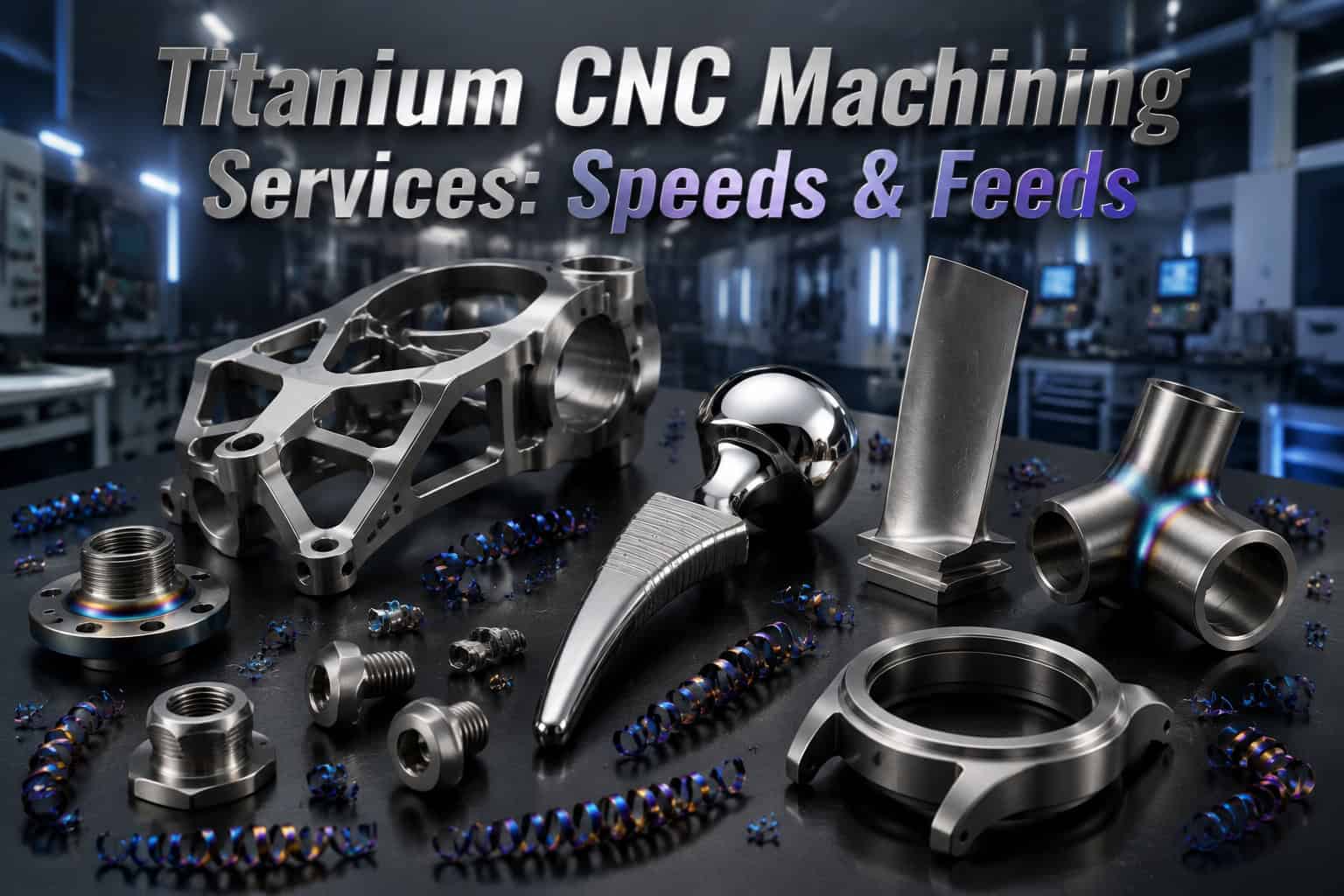
Unalloyed commercially pure (CP) titanium grades (Grades 1–4) offer high ductility and corrosion resistance but lower tensile strength. Alpha-beta alloys, dominated by Grade 5 (Ti-6Al-4V), dominate aerospace and industrial engineering due to their high yield strength (≥880 MPa) and fatigue limit. However, their mechanical traits complicate cnc titanium operations by concentrating thermal energy at the cutting line.
| Grade / Alloy | ASTM Type | Tensile Strength (MPa) | Yield Strength (MPa) | Machinability Index (CP Gr.1 = 100%) |
|---|---|---|---|---|
| Grade 1 (CP) | Alpha | 240 | 170 | 100% |
| Grade 2 (CP) | Alpha | 345 | 275 | 80% |
| Grade 5 (Ti-6Al-4V) | Alpha-Beta | 950 | 880 | 22% |
| Grade 7 (Ti-0.2Pd) | Alpha | 345 | 275 | 75% |
| Grade 23 (Ti-6Al-4V ELI) | Alpha-Beta | 860 | 790 | 25% |
What is Machinability in Titanium Alloys?
Machinability measures how easily a metal can be cut to specified dimensions and surface finishes without causing premature tool failure. For titanium, machinability ratings drop sharply (to roughly 20-25% compared to baseline free-cutting steel) due to three physical mechanisms:
- Low Thermal Conductivity: Heat cannot escape through titanium chips, remaining concentrated at the tool-chip interface (~1,000°C).
- Low Modulus of Elasticity: Titanium’s elasticity (~110 GPa vs. ~200 GPa in steel) causes parts to deflect away from the tool, triggering chatter, spring-back, and dimensional drift.
- Chemical Reactivity: At temperatures above 500°C, titanium reacts chemically with carbide tool elements, causing galling, welding, and notch wear along the tool flank.
To overcome these barrier properties, high-reliability engineering facilities, such as Boraco Machining, utilize high-pressure coolant (HPC) delivery systems operating at 70–100 bar. High-pressure streams shatter the vapor blanket formed at the cutting edge, flushing chips clear while preventing thermal micro-cracking across precision surfaces.
Calculated Speeds, Feeds, and Cutting Geometry for Titanium Milling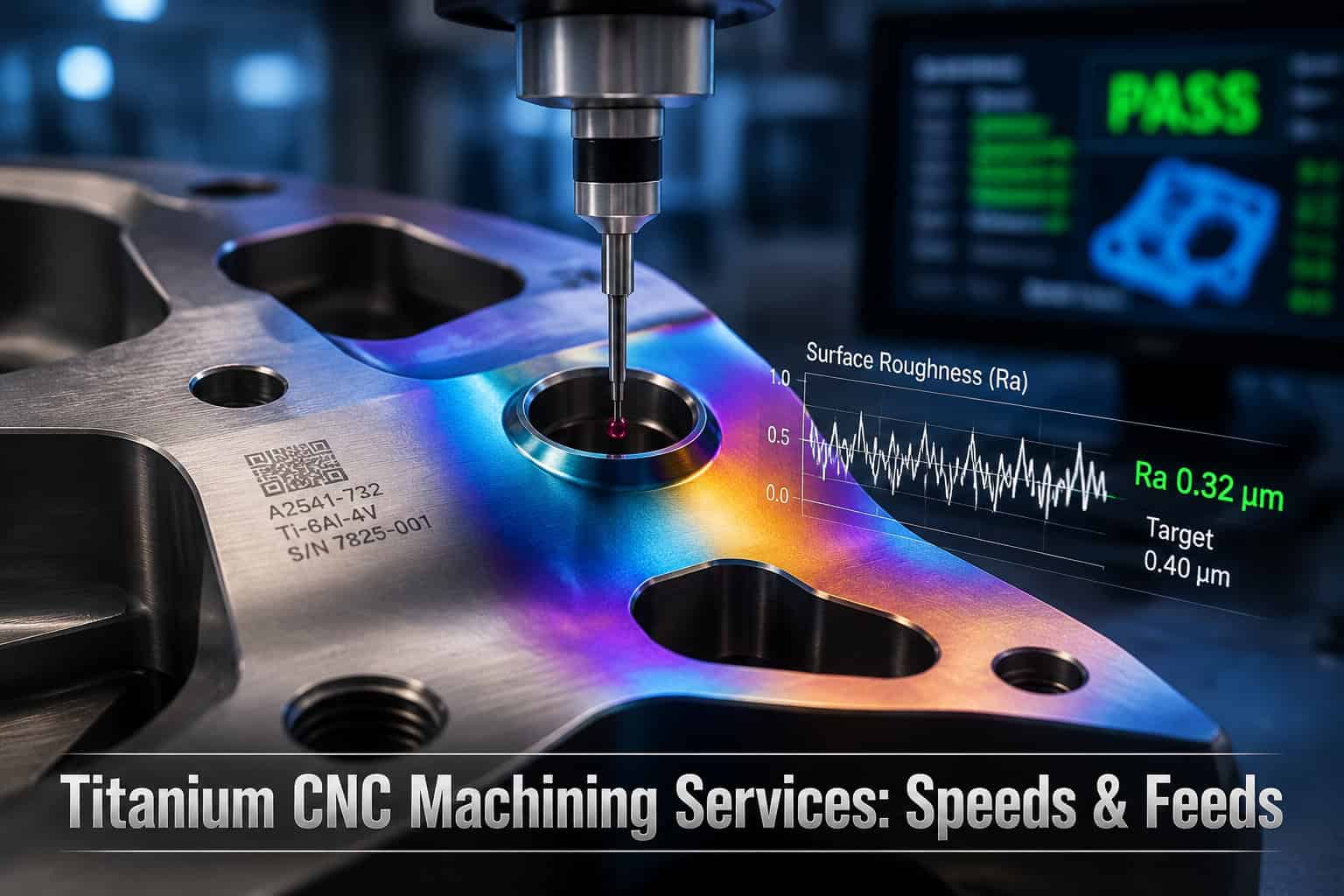
Successful titanium milling requires controlling heat generation while maintaining continuous forward chip load. Lingering in a cut causes immediate work-hardening, which destroys carbide cutting edges within seconds. Operators must balance surface speed ($V_c$), feed per tooth ($f_z$), and depth of cut ($a_p$/$a_e$) to maximize metal removal rates (MRR) while maintaining tool life.
Solid carbide end mills designed for titanium rely on unequal helix angles (e.g., 35°/38°) to disrupt harmonic chatter. AlTiN (Aluminum Titanium Nitride) or TiAlN PVD coatings are necessary to create a thermal barrier over the carbide substrate, extending insert survivability under continuous contact.
| Operation Type | Surface Speed ($V_c$, m/min) | Feed per Tooth ($f_z$, mm/flute) | Axial Depth ($a_p$) | Radial Engagement ($a_e$) |
|---|---|---|---|---|
| Rough Milling (Grade 5) | 45 – 65 | 0.08 – 0.12 | 1.0 × Diameter | 0.25 – 0.50 × Diameter |
| Finish Milling (Grade 5) | 65 – 90 | 0.04 – 0.08 | 1.5 × Diameter | 0.05 – 0.10 × Diameter |
| Trochoidal / High-Speed Milling | 100 – 150 | 0.10 – 0.18 | 2.0 × Diameter | 0.05 – 0.08 × Diameter |
| Face Milling (Indexable) | 40 – 60 | 0.10 – 0.15 | 1.5 – 3.0 mm | 0.65 – 0.80 × Cutter Dia |
High-speed trochoidal milling strategies yield excellent results in titanium slot milling. By maintaining low radial engagement ($a_e \le 10\%$) and high axial engagement ($a_p \ge 2xD$), heat distributes across a longer cutting edge. This technique keeps tool contact times short, giving the cutting edge time to cool between revolutions.
When sourcing high-precision aerospace components, verifying cutting parameters ensures part accuracy. Reach out to our engineering team through our Contact Us page to review your mill-turn toolpaths and manufacturing schedules.
Precision Turning Titanium: Tooling and Thermal Control Strategies
Precision turning titanium operations—including facing, grooving, and thread cutting—demand rigid workholding to counteract cutting force spikes. Because titanium deflections can throw off tight tolerances, chuck pressure, tailstock support, and steady rests must be calculated carefully to prevent part distortion.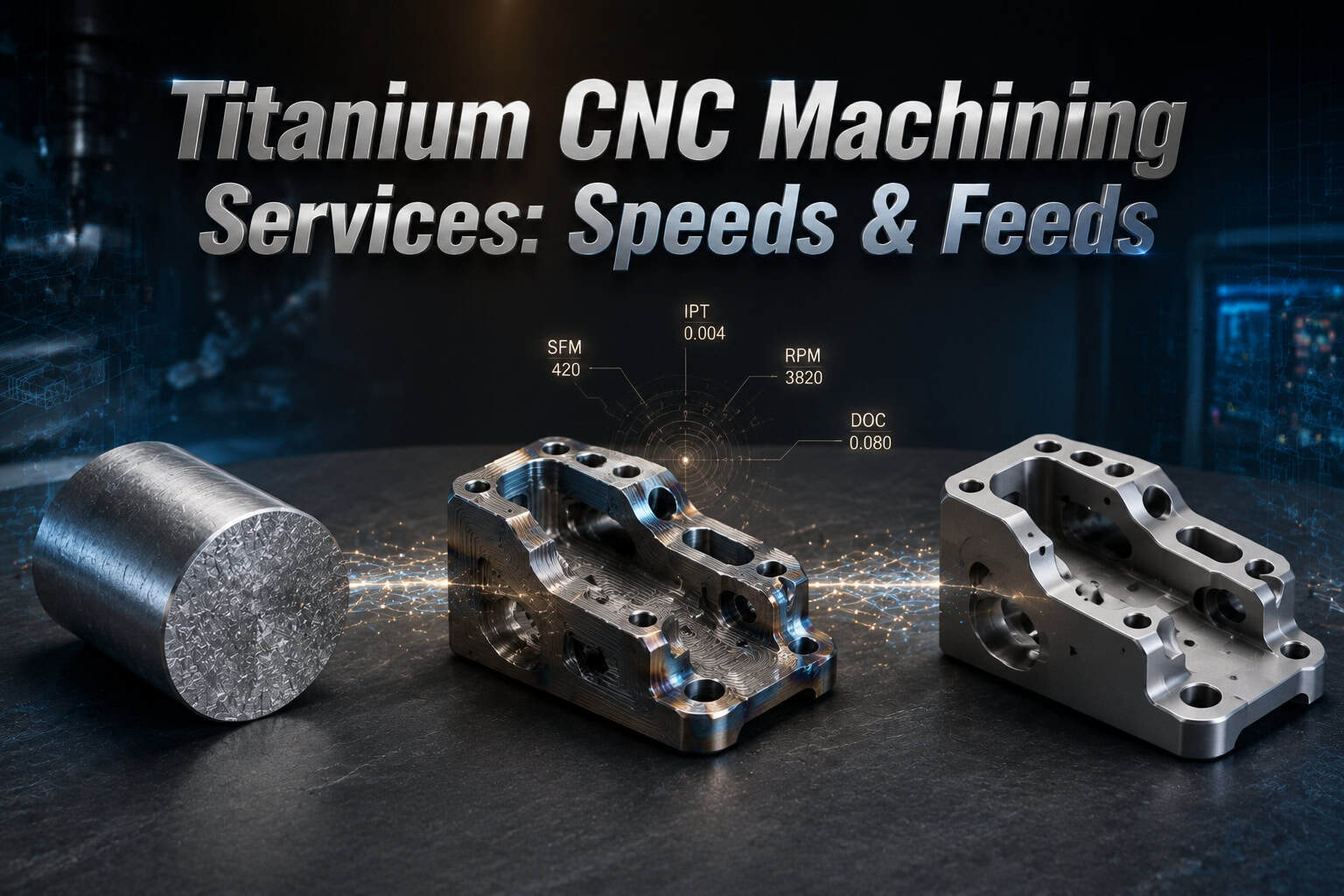
Insert geometries for turning titanium require sharp cutting edges combined with positive rake angles (6° to 10°). Honed or round-edge inserts increase friction, elevating localized temperatures and triggering work-hardening. Uncoated or thin-PVD coated C2/C3 micrograin carbide inserts are preferred over thick CVD coatings, which tend to lack the edge sharpness needed to sheer titanium cleanly.
Key Parameters for Turning Operations:
- External Turning (Roughing): $V_c = 50\text{–}70\text{ m/min}$, feed rate $f = 0.15\text{–}0.25\text{ mm/rev}$, depth of cut $a_p = 1.5\text{–}3.0\text{ mm}$.
- External Turning (Finishing): $V_c = 75\text{–}105\text{ m/min}$, feed rate $f = 0.05\text{–}0.12\text{ mm/rev}$, depth of cut $a_p = 0.25\text{–}0.50\text{ mm}$.
- Threading: Pass count must be increased by 20–30% compared to medium-carbon steel schedules, using modified flank infeed angles (29°) to prevent insert tip binding.
Controlling heat generation requires maintaining a positive feed throughout the cut. Pausing a feed movement while turning titanium causes immediate localized work-hardening, leading to insert notch failure on subsequent passes. For comprehensive technical specs on specialized turning capabilities, review our core titanium machining services.
5-Axis Machining and Modern Manufacturing Trends for Titanium Components
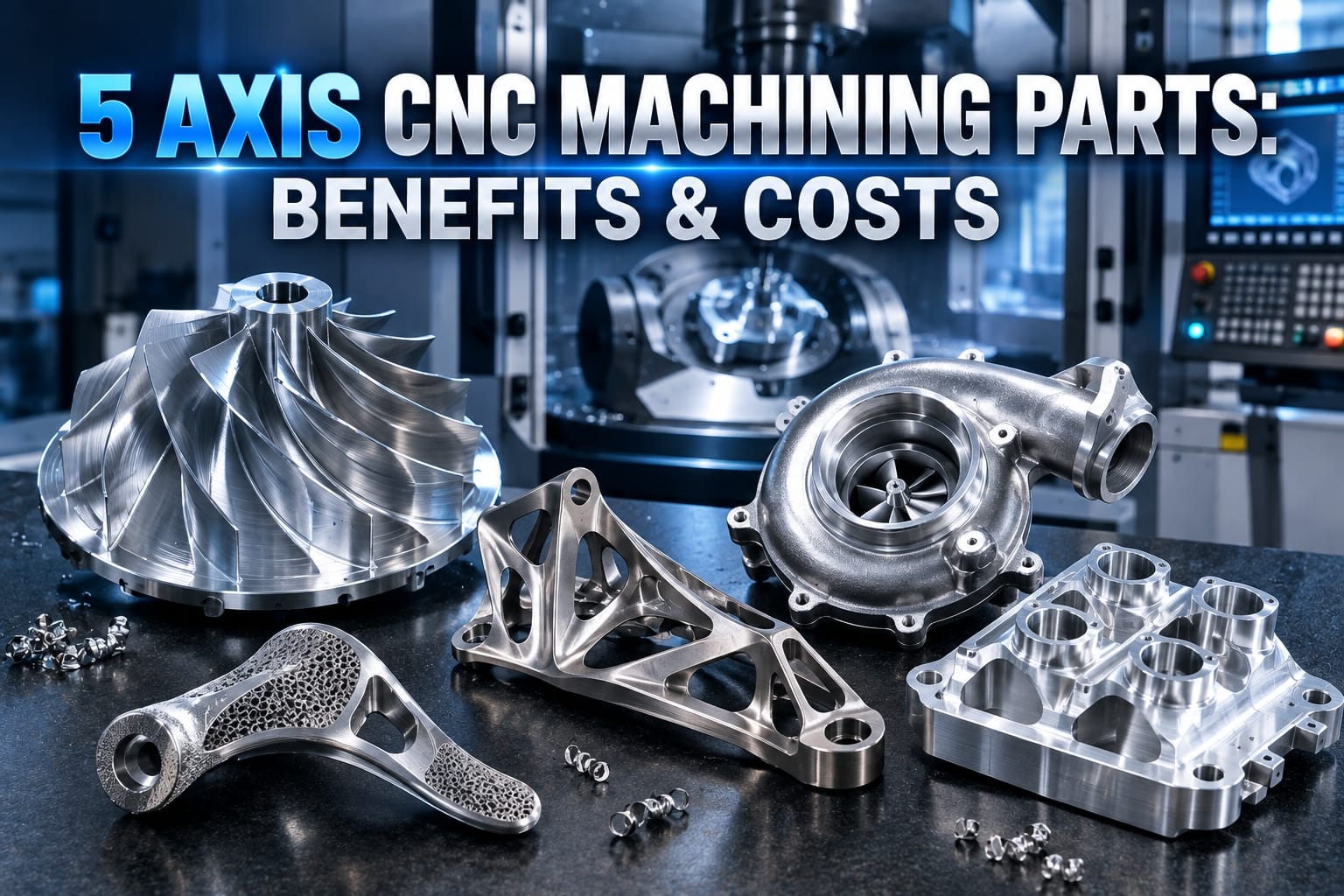
Aerospace bulkheads, blisks, and engine mount brackets feature organic geometries, deep pockets, and thin walls. Traditional multi-setup 3-axis milling often introduces positioning errors across complex parts. Applying 5-axis titanium CNC machining minimizes cumulative setup errors by completing parts in single-setup operations.
5-axis machining also enables dynamic tool angle control. By tilting the spindle, tools maintain optimal contact angles relative to the workpiece surface. This prevents cutting at the dead center of ball-nose end mills—where surface speed drops to zero—improving tool life and surface finish quality.
Integrating Additive and Subtractive Manufacturing
Combining additive manufacturing (3D printing) with subtractive CNC finishing reduces material waste in titanium production. While 3D printing forms near-net-shape titanium parts, laser powder bed fusion leaves rough surface finishes (Ra 10–15 µm) and dimensional tolerances unsuited for sealing surfaces or bearing fits.
Modern production workflows use 5-axis CNC machining to finish critical features—such as mating faces, threaded holes, and bore tolerances—on 3D-printed titanium blanks. This hybrid approach slashes raw material consumption (buy-to-fly ratio) from 15:1 down to under 3:1 while maintaining tight tolerance specs ($\pm0.005\text{ mm}$). For more about our history and precision equipment, visit our About Us page.
Surface Treatments: Anodizing, Passivation, and Finishing Services
Titanium naturally forms a protective oxide layer ($TiO_2$) when exposed to oxygen. However, high-friction aerospace environments or medical applications often require enhanced surface treatments to boost corrosion resistance, improve lubricity, or prevent wear.
| Treatment Type | Standard Specification | Layer Thickness | Primary Engineering Purpose |
|---|---|---|---|
| Type I Anodizing | AMS 2488 Type I | Thin Film (<0.1 µm) | High-temperature lubrication base, anti-galling. |
| Type II Anodizing | AMS 2488 Type II | 0.5 – 2.5 µm | Wear resistance, fatigue strength maintenance, anti-galling. |
| Type III Anodizing (Color) | ISO 15730 / Commercial | 15 – 50 nm (Interference) | Color coding for medical instruments, optical identification. |
| Citric/Nitric Passivation | ASTM F86 / AMS 2700 | N/A (Chemical Clean) | Removes free iron contamination from machining tools. |
When specifying anodizing titanium operations, engineering drawings must account for material removal or dimensional build-up. Type II anodizing converts the outer titanium layer into a durable oxide shell without causing dimensional growth, making it ideal for tight-tolerance aerospace threads and bearing journals.
Frequently Asked Questions (FAQ)
Why is titanium difficult to cut during CNC machining?
Titanium exhibits low thermal conductivity (approx. 6.7 to 7.2 W/m·K for Ti-6Al-4V), meaning heat accumulates at the tool cutting edge rather than dissipating into the chip. Combined with a low elastic modulus that causes material spring-back and high chemical reactivity at elevated temperatures, tool wear accelerates rapidly without strict heat management.
What cutting fluid setup works best for turning titanium?
High-pressure coolant systems operating at 70 bar (1,000 psi) or higher directed precisely into the cut zone yield the best results. High pressure fractures the heat barrier, flushes chips out of narrow cuts, and prevents built-up edge (BUE) formation on solid carbide inserts.
Which titanium alloy grade offers the best balance of strength and machinability?
Grade 5 (Ti-6Al-4V) is the industry standard balance point. It delivers tensile strength around 900–950 MPa while retaining sufficient ductility to remain predictably machinable using high-performance carbide tooling and optimized speeds and feeds.
What surface finishes can be achieved on custom titanium parts?
As-machined titanium components typically reach surface roughness values between Ra 0.8 µm and Ra 1.6 µm. Secondary processes like bead blasting, mechanical polishing, or Type II and Type III anodizing titanium can refine surface finish below Ra 0.4 µm while adding protective oxide layers.
Summary: Precision Titanium Manufacturing Delivers Critical Value
Machining titanium requires controlling heat generation, choosing optimized insert geometries, and maintaining constant tool engagement. Partnering with a skilled precision machining supplier helps aerospace and medical OEMs produce high-performance titanium parts reliably while meeting strict delivery schedules.
Ready to optimize your custom titanium parts for full-scale production? Submit your CAD models and technical requirements through our Request a Quote form to get a detailed manufacturability review from our engineering team.