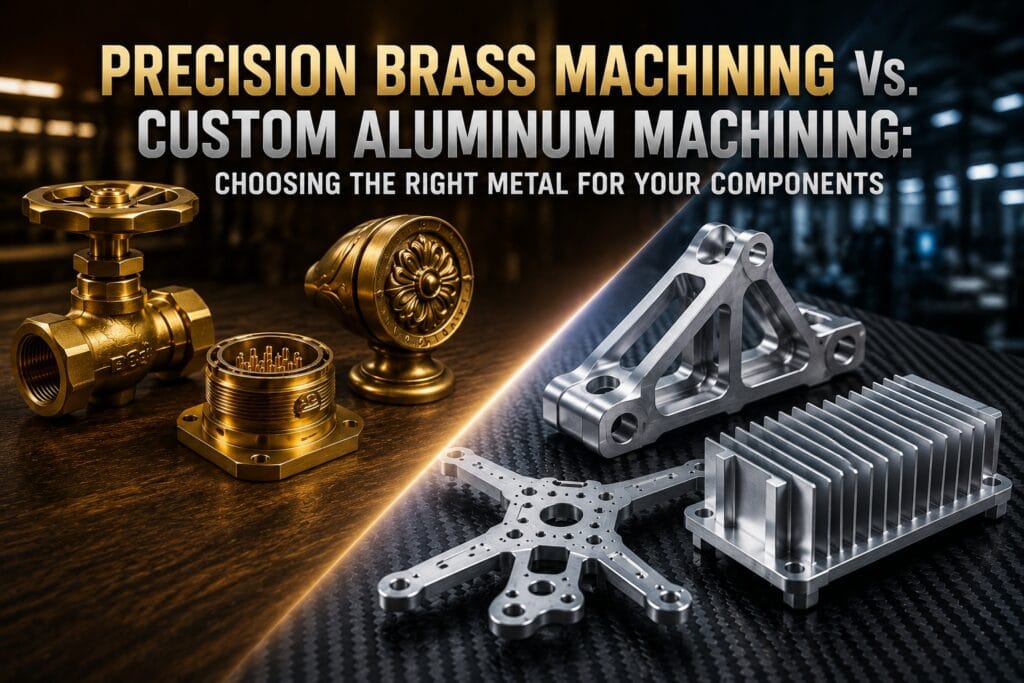

Precision Brass Machining vs. Custom Aluminum Machining
Sourcing the wrong metal for precision components risks catastrophic mechanical failure and budget overruns. This engineering guide compares precision brass machining vs. custom aluminum machining to help you select the ideal alloy for your application requirements.
Mechanical and Thermal Properties: Material Selection Matrix
Selecting between copper-based brass and lightweight aluminum requires a granular understanding of material science. Procurement professionals must balance mechanical stress profiles against environmental exposure. While aluminum is celebrated for its strength-to-weight ratio, brass offers superior low-friction characteristics and unique acoustic and electrical properties.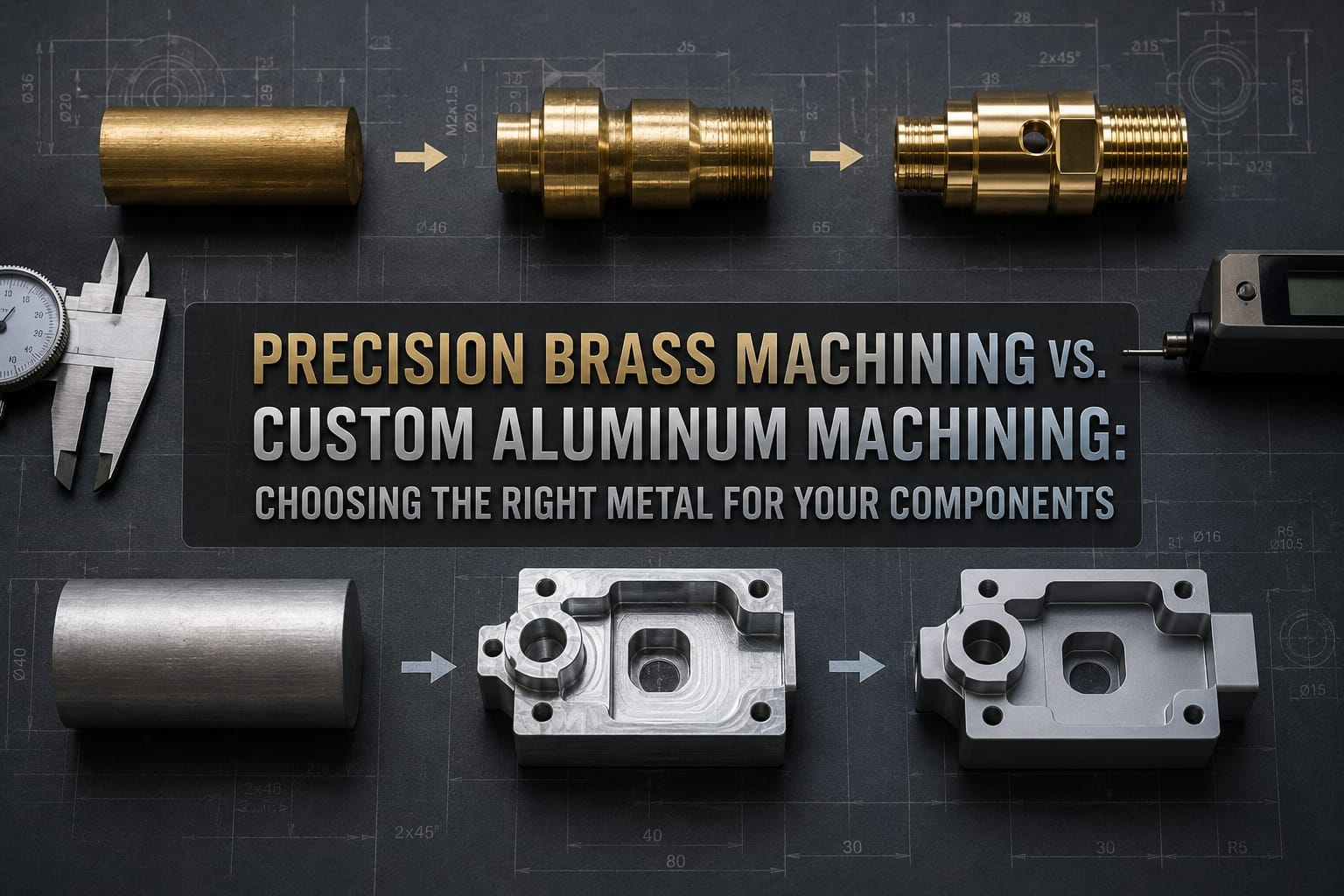
Engineers analyzing complex assemblies often look to material standards established by organizations like ASTM International to verify exact mechanical limits before launching a production run. Miscalculating thermal expansion or yield strength under load can result in dimensional instability during operation, particularly in high-vibration applications such as automotive part machining.
| Material Property | Brass (C36000 Free-Cutting) | Aluminum (6061-T6) | Aluminum (7075-T6) |
|---|---|---|---|
| Density (g/cm³) | 8.50 | 2.70 | 2.81 |
| Yield Strength (MPa) | 310 | 276 | 503 |
| Thermal Conductivity (W/m·K) | 115 | 167 | 130 |
| Electrical Conductivity (% IACS) | 26 | 43 | 33 |
| Coefficient of Thermal Expansion (µm/m·°C) | 20.5 | 23.5 | 23.2 |
| Achievable Machining Tolerance (mm) | ±0.005 | ±0.010 | ±0.008 |
The high density of brass increases the overall weight of the assembly, making it less suitable for aerospace structures but highly desirable for stable, heavy precision machining applications. Conversely, custom aluminum machining delivers components with excellent structural integrity at one-third the weight of brass, which is critical for moving parts and portable systems.
What is Machinability? Understanding Deflection and Cycle Times
Technical Definition Block: Machinability Index
Machinability is a relative metric used to quantify how easily a material can be cut, shaped, or finished using machine tools. It is calculated based on cutting speed, surface finish quality, tool wear rates, and chip formation dynamics. The baseline standard is set by C3600 Free-Cutting Brass, which is assigned a 100% Machinability Index rating. All other engineering materials are measured against this benchmark.
When optimizing production costs for high volume cnc machining, machinability directly correlates to cycle times and tool replacement intervals. Brass generates minimal tool wear and forms brittle, easily cleared chips. This allows CNC milling spindles to operate at maximum feed rates without risk of tool breakage, reducing machine overhead costs significantly.
Aluminum alloys, while highly machinable compared to stainless steel, exhibit a “gummy” behavior during cutting. Aluminum chips tend to weld themselves to the cutting edges of carbide tools, a phenomenon known as Built-Up Edge (BUE). To prevent tool failure and maintain strict surface roughness targets, technicians must utilize precise coolant pressures and specialized diamond-like carbon (DLC) tool coatings during small batch cnc machining campaigns.
Material stability during aggressive stock removal is another critical variable. Aluminum retains more residual stress from rolling or extrusion processes than brass. When executing deep pocket milling or complex turning operations, these internal stresses release, causing component warping or distortion. Brass remains highly dimensionally stable after heavy machining, allowing engineers to hold tolerances tighter than ±0.005 mm without extensive stress-relief annealing steps.
If your project demands high-precision execution across demanding geometries, securing an experienced manufacturing partner is vital. You can reach out directly to our engineering team to review your technical drawings and optimize your design for manufacturing: Contact Boraco Machining for an Engineering Review.
Corrosion Resistance, Finishing, and Surface Integrity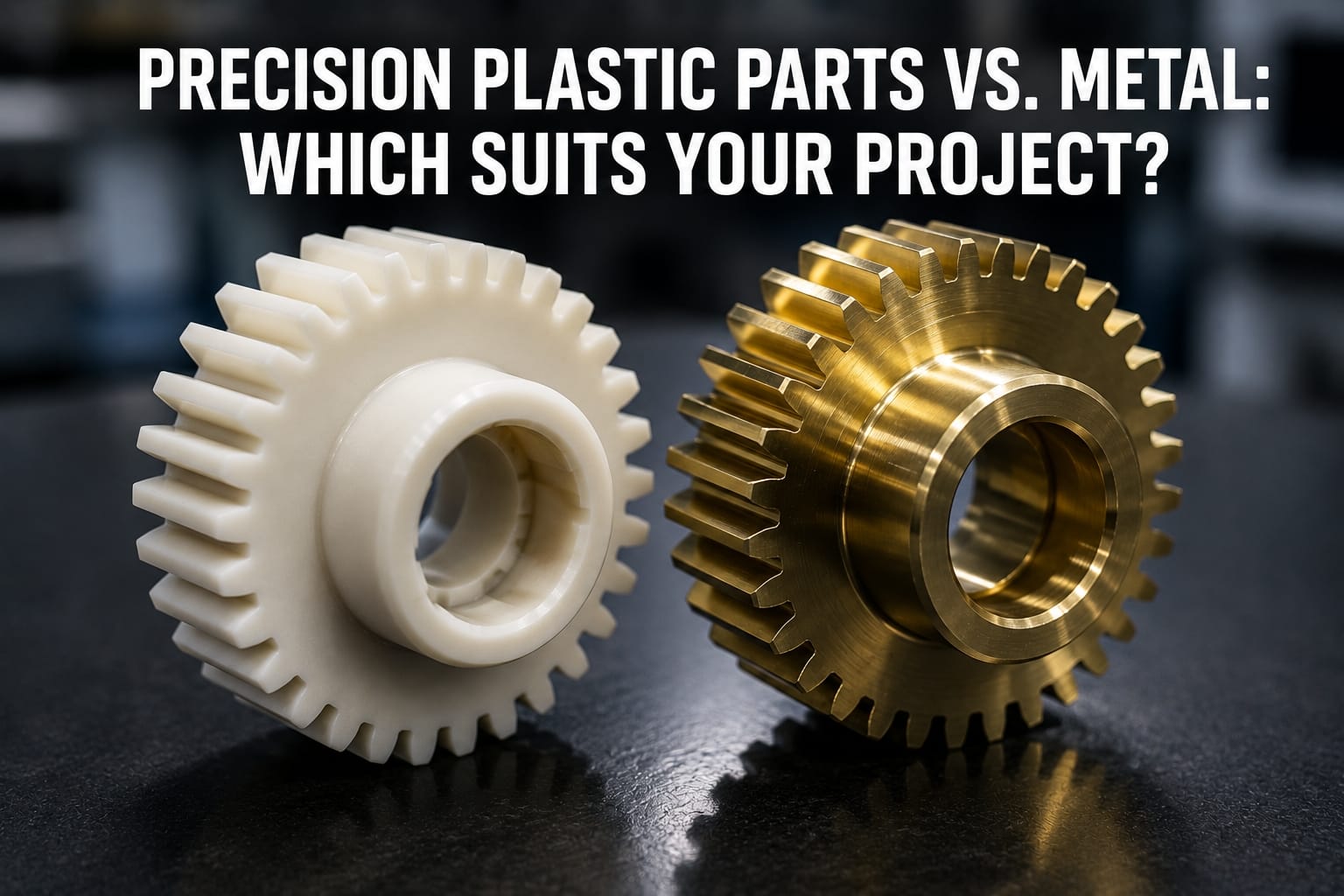
Industrial environments expose mechanical parts to moisture, chemical vapors, and galvanic reactions. Component longevity depends heavily on the chosen alloy’s inherent chemical stability or its compatibility with protective surface treatments. Brass and aluminum react entirely differently when exposed to corrosive elements.
Brass naturally forms a protective, thin oxide layer that resists atmospheric corrosion, fresh water, and mild chemicals. It does not rust. However, brass is susceptible to dezincification when exposed to acids or high-temperature salt water, where the zinc content leaches out, leaving a porous, weakened copper matrix. For components used in marine environments or chemical processing, specific low-lead or arsenical brass alloys must be specified.
Aluminum forms an instantaneous, microscopic aluminum oxide layer when exposed to oxygen, providing excellent base protection. This layer can be engineered to extreme hardness through electrochemical processes. Anodizing increases wear resistance and electrical insulation properties, transforming custom aluminum machining surfaces into highly durable barriers suitable for industrial applications.
| Surface Finish Process | Application to Aluminum | Application to Brass | Primary Engineering Benefit |
|---|---|---|---|
| Type II Anodizing | Excellent compatibility | Not applicable | Corrosion protection; aesthetic coloring |
| Type III Hardcoat Anodizing | Excellent (adds 50-100 µm layer) | Not applicable | Extreme wear resistance; high surface hardness |
| Electroless Nickel Plating | Requires zincate pre-treatment | Direct application | Uniform thickness; exceptional chemical barrier |
| Passivation / Chromate Conversion | Excellent (Alodine coatings) | Excellent (Acid dipping) | Maintains electrical conductivity; paint adhesion |
For applications in electronics cnc machining, where grounding and electromagnetic shielding (EMI) are required, bare brass or passivated aluminum is preferred over anodized aluminum. Anodized surfaces act as electrical insulators, which can break continuity within an enclosure unless specific masking is applied during the chemical processing phase.
Industry-Specific Applications: Choosing the Metal for Your Sector
The choice between precision brass machining vs. custom aluminum machining is often dictated by the historical compliance data and operating environments of specific industries. Neither material is a universal solution; each serves a targeted niche within global supply chains.
Electronics and Enclosure Manufacturing
In electronic applications, thermal management and electrical conductivity rule the design architecture. Aluminum 6061 is the standard for machining thermal heatsinks and lightweight structural enclosures due to its superior thermal conductivity compared to brass. When weight reduction is prioritized for hand-held industrial equipment or aerospace avionics, aluminum remains uncontested. However, internal coaxial connectors, RF shielding blocks, and terminal pins are heavily dominated by precision brass machining due to its excellent solderability, compliance, and wear resistance during repetitive mating cycles.
Automotive and Heavy Machinery
Modern automotive manufacturing relies on lightweight materials to improve fuel efficiency and vehicle dynamics. Components like manifolds, suspension knuckles, and fluid valve blocks utilize custom aluminum machining to minimize unsprung weight. Concurrently, heavy component machining and high-wear automotive systems require the self-lubricating properties of brass. Gearbox synchronizer rings, fuel injection nozzles, and hydraulic bushings rely on machined brass to withstand high mechanical friction without galling or seizing against steel mating shafts.
For large-scale industrial assemblies requiring a combination of robust framework and tight tolerances, sourcing teams often transition projects to professional china cnc machining suppliers who can manage integrated machining and fabrication workflows. Combining CNC milling with precision sheet metal fab processes allows for cost-effective structural builds that combine heavy machined blocks with lightweight sheet enclosures.
Evaluating Total Cost: Production Volume and Lifecycle Value
Procurement teams must look beyond raw material spot prices per kilogram when calculating the total cost of ownership (TCO) for a production batch. The interplay between material cost, machine cycle times, tool consumption, and recycling value determines the final line-item cost on an invoice.
Raw brass is substantially more expensive than raw aluminum on a per-kilogram basis. However, because brass can be machined up to three times faster than aluminum with minimal tool wear, the labor and machine overhead costs per part are significantly lower. In high volume cnc machining environments, this reduction in machine cycle time completely offsets the higher initial material cost of brass.
Furthermore, brass scrap retention value is exceptionally high. Turnings, chips, and swarf generated during precision brass machining can be reclaimed and sold back to foundries at up to 70% to 80% of the original raw material value. Aluminum chips also possess recycling value, but the percentage return is lower due to higher oxidation losses during re-smelting. For complex parts where more than 50% of the initial stock block is converted into chips, brass frequently emerges as the more economical choice for high-volume production runs.
When engineering low-volume components or complex prototypes, the material cost dominates the equation because recycling logistics are not economically viable for small scrap volumes. In these scenarios, utilizing cnc machining prototyping services with aluminum alloys minimizes upfront capital expenditure while validating mechanical designs before committing to mass production tooling.
To obtain an accurate, optimized cost breakdown tailored to your specific production volumes and dimensional tolerances, submit your STEP files directly to our estimation engineers: Request a Precision Manufacturing Quote.
Conclusion
Choosing between precision brass machining vs. custom aluminum machining requires balancing structural weight limitations against machine cycle times and environmental wear factors. Aluminum provides structural efficiency and superior thermal management for aerospace and electronic enclosures, while brass delivers unmatched machinability, tight dimensional tolerances, and natural low-friction performance for industrial wear components. Partnering with an ISO 9001:2015 certified manufacturer ensures that your material parameters, surface finishes, and design tolerances are precisely maintained from prototype to mass production.
Ready to optimize your component manufacturing and reduce lead times? Contact Boraco Machining today to receive a detailed technical quote within 24 hours.
Frequently Asked Questions (FAQ)
Which material allows for tighter tolerances: brass or aluminum?
Brass consistently allows for tighter machining tolerances (down to ±0.005 mm) compared to aluminum. Brass exhibits minimal internal residual stress and high structural stability during cutting, preventing the part deformation or warping that can occur when machining complex aluminum configurations.
Is brass or aluminum better suited for high-frequency electronic connectors?
Brass is highly preferred for electrical connectors and terminal pins due to its superior solderability, corrosion resistance, and constant electrical contact resistance over repeated cycles. While aluminum has higher bulk electrical conductivity per gram, its tendency to form a non-conductive oxide layer makes it less reliable for direct electrical contact surfaces without specialized plating.
How does the scrap recycling value impact the total production cost of brass components?
Brass turnings and chips have an exceptionally high recovery value, often fetching up to 80% of raw material costs. In high-volume production where a large percentage of the material is removed, reclaiming this scrap significantly offsets the initial material expense, making brass highly cost-competitive with aluminum.
Can aluminum be used as a direct substitute for brass in marine environments?
Aluminum can only substitute for brass in marine environments if it is properly treated, such as through marine-grade anodizing or specialized coatings (e.g., 5000 or 6000-series alloys). Raw aluminum is highly susceptible to galvanic and pitting corrosion in salt water if it comes into contact with other metals, whereas marine-grade brasses resist these environments inherently.